

Medal count - the fate of nations at the Olympics. How national wealth, democratic government, genetics, immigration and sports accessibility enable athletic empowerment that explains Olympic success
(Medaillenspiegel - das Schicksal der Nationen bei den Olympischen Spielen. Wie nationaler Wohlstand, demokratische Regierungsformen, Genetik, Einwanderung und der Zugang zum Sport die sportliche Leistungsfähigkeit fördern, die den olympischen Erfolg erklärt)
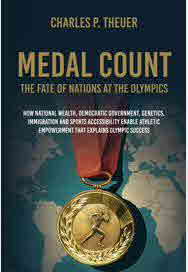
This book explores complex factors that determine Olympic success, exploring why certain nations consistently dominate the medal tables while others struggle to secure even a single medal. Dr. Theuer, a physician and epidemiologist, applies statistical analyses to uncover the national characteristics that drive Olympic achievement, focusing on measurable factors such as national wealth and democratic governance. But the book also examines less quantifiable influences - genetics, the impact of immigration, and sports accessibility - providing a multifaceted view of athletic empowerment. In a sense, the book explores human empowerment viewed through the lens of Olympic success.
Drawing inspiration from works like Freakonomics by Steven Levitt and Stephen Dubner, Outliers by Malcolm Gladwell, and Factfulness by Hans Rosling, Medal Count - The Fate of Nations at the Olympics uses mathematics and socioeconomics to answer the question: What accounts for Olympic success? While national wealth is the most significant contributor, the book reveals that there are deeper, more nuanced factors that nations can leverage to empower their athletes. Through detailed case studies, Dr. Theuer illustrates how Norway far outperforms expectations through maximal athletic empowerment, winning Olympic medals at rates 48 times higher than would be expected based on its population size. In contrast, countries with extreme poverty or rigid caste systems, such as most sub-Saharan African nations or India and Pakistan, face challenges in achieving Olympic success. Genetic diversity, spurred by immigration into wealthy countries, plays a role in boosting athletic performance, though it is a less tangible factor.
The book also examines nations that excel in less capital-intensive sports, such as Jamaica`s and Kenya`s dominance in track and field, Fiji`s success in rugby, and Kyrgyzstan`s success in wrestling despite lacking vast wealth or large populations. Dr. Theuer proposes a model of athletic empowerment, showing that nations can apply lessons from Olympic success to foster not only greater sports achievement but broader societal progress. Ultimately, Medal Count - The Fate of Nations at the Olympics argues that athletic empowerment is a key form of human empowerment, with positive effects that ripple out into many aspects of society, leading to success beyond the sports arena. Klappentext
© Copyright 2025 Veröffentlicht von Universal Publishers. Alle Rechte vorbehalten.
| Schlagworte: | |
|---|---|
| Notationen: | Sportgeschichte und Sportpolitik Theorie und gesellschaftliche Grundlagen Leitung und Organisation |
| Sprache: | Englisch |
| Veröffentlicht: |
Irvine; Boca Raton
Universal Publishers
2025
|
| Online-Zugang: | https://www.universal-publishers.com/book.php?method=ISBN&book=1599427664 |
| Seiten: | 73 |
| Dokumentenarten: | Buch |
| Level: | hoch |