

Is daytime napping an effective strategy to improve sport-related cognitive and physical performance and reduce fatigue? A systematic review and meta-analysis of randomised controlled trials
(Ist ein Nickerchen am Tag eine wirksame Strategie zur Verbesserung der sportbezogenen kognitiven und körperlichen Leistungsfähigkeit und zur Verringerung der Müdigkeit? Eine systematische Überprüfung und Meta-Analyse randomisierter kontrollierter Studien)
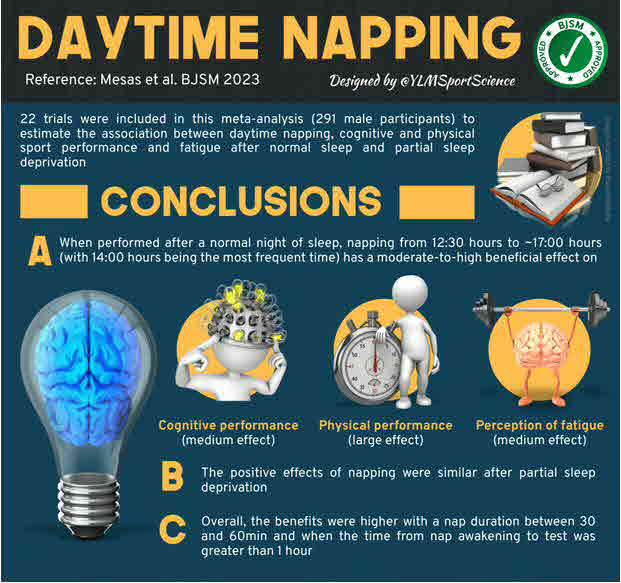
© Copyright 2023 YLMSportScience. Alle Rechte vorbehalten.
Abstract
Objective: To estimate the association between daytime napping and cognitive and physical sport performance and fatigue after normal sleep and partial sleep deprivation (less sleep duration than necessary).
Design: Systematic review and meta-analysis.
Data sources: The PubMed, Scopus, Web of Science, Cochrane Central, SportDiscus and PsycINFO databases.
Eligibility criteria for selecting studies: Randomised controlled trials on the effect of daytime napping on sport performance and fatigue available from inception to 2 December 2022. Standardised mean differences (SMD) and their 95% compatibility intervals (CI) were estimated with the DerSimonian-Laird method through random effect models.
Results: In the 22 included trials, 291 male participants (164 trained athletes and 127 physically active adults) aged between 18 and 35 years were studied. When performed after a normal night of sleep, napping from 12:30 hours to 16:50 hours (with 14:00 hours being the most frequent time) improved cognitive (SMD=0.69, 95% CI: 0.37 to 1.00; I2=71.5%) and physical performance (SMD=0.99, 95% CI: 0.67 to 1.31; I2=89.1%) and reduced the perception of fatigue (SMD=-0.76, 95% CI: -1.24 to -0.28; I2=89.5%). The positive effects of napping were also confirmed after partial sleep deprivation. Overall, the benefits were higher with a nap duration between 30 and <60 min and when the time from nap awakening to test was greater than 1 hour.
Conclusions: After a night of normal sleep or partial sleep deprivation, a daytime nap between 30 and <60 min has a moderate-to-high effect on the improvement of cognitive performance and physical performance and on the reduction of perceived fatigue.
© Copyright 2023 British Journal of Sports Medicine. BMJ Publishing Group Ltd of the BMA. Alle Rechte vorbehalten.
| Schlagworte: | |
|---|---|
| Notationen: | Biowissenschaften und Sportmedizin Trainingswissenschaft |
| Veröffentlicht in: | British Journal of Sports Medicine |
| Sprache: | Englisch |
| Veröffentlicht: |
2023
|
| Jahrgang: | 57 |
| Seiten: | 417-426 |
| Dokumentenarten: | Artikel |
| Level: | hoch |