

Impact of cold-water immersion compared with passive recovery following a single bout of strenuous exercise on athletic performance in physically active participants: a systematic review with meta-analysis and meta-regression
(Auswirkung des Eintauchens in kaltes Wasser im Vergleich zur passiven Erholung nach einem einzelnen anstrengenden Training auf die sportliche Leistung von körperlich aktiven Teilnehmern: eine systematische Überprüfung mit Metaanalyse und Metaregression)
© Copyright 2022 YLMSportScience. Alle Rechte vorbehalten.
Background: Studies investigating the effects of cold-water immersion (CWI) on the recovery of athletic performance, perceptual measures and creatine kinase (CK) have reported mixed results in physically active populations.
Objectives: The purpose of this systematic review was to investigate the effects of CWI on recovery of athletic performance, perceptual measures and CK following an acute bout of exercise in physically active populations.
Study Design: Systematic review with meta-analysis and meta-regression.
Methods: A systematic search was conducted in September 2021 using Medline, SPORTDiscus, Scopus, Web of Science, Cochrane Library, EmCare and Embase databases. Studies were included if they were peer reviewed and published in English, included participants who were involved in sport or deemed physically active, compared CWI with passive recovery methods following an acute bout of strenuous exercise and included athletic performance, athlete perception and CK outcome measures. Studies were divided into two strenuous exercise subgroups: eccentric exercise and high-intensity exercise. Random effects meta-analyses were used to determine standardised mean differences (SMD) with 95% confidence intervals. Meta-regression analyses were completed with water temperature and exposure durations as continuous moderator variables.
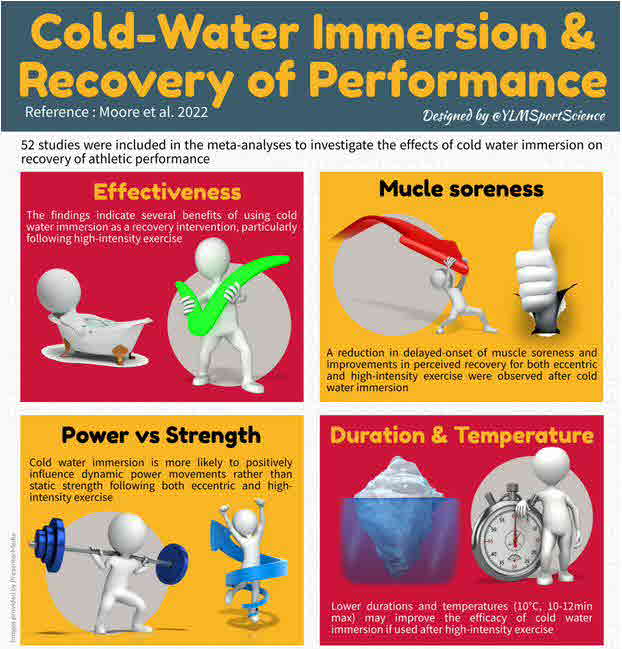
Results: Fifty-two studies were included in the meta-analyses. CWI improved the recovery of muscular power 24 h after eccentric exercise (SMD 0.34 [95% CI 0.06-0.62]) and after high-intensity exercise (SMD 0.22 [95% CI 0.004-0.43]), and reduced serum CK (SMD - 0.85 [95% CI - 1.61 to - 0.08]) 24 h after high-intensity exercise. CWI also improved muscle soreness (SMD - 0.89 [95% CI - 1.48 to - 0.29]) and perceived feelings of recovery (SMD 0.66 [95% CI 0.29-1.03]) 24 h after high-intensity exercise. There was no significant influence on the recovery of strength performance following either eccentric or high-intensity exercise. Meta-regression indicated that shorter time and lower temperatures were related to the largest beneficial effects on serum CK (duration and temperature dose effects) and endurance performance (duration dose effects only) after high-intensity exercise.
Conclusion: CWI was an effective recovery tool after high-intensity exercise, with positive outcomes occurring for muscular power, muscle soreness, CK, and perceived recovery 24 h after exercise. However, after eccentric exercise, CWI was only effective for positively influencing muscular power 24 h after exercise. Dose-response relationships emerged for positively influencing endurance performance and reducing serum CK, indicating that shorter durations and lower temperatures may improve the efficacy of CWI if used after high-intensity exercise.
© Copyright 2022 Sports Medicine. Springer. Alle Rechte vorbehalten.
| Schlagworte: | |
|---|---|
| Notationen: | Biowissenschaften und Sportmedizin Trainingswissenschaft |
| Tagging: | Kaltwasseranwendung |
| Veröffentlicht in: | Sports Medicine |
| Sprache: | Englisch |
| Veröffentlicht: |
2022
|
| Online-Zugang: | https://doi.org/10.1007/s40279-022-01644-9 |
| Jahrgang: | 52 |
| Heft: | 7 |
| Seiten: | 1667-1688 |
| Dokumentenarten: | Artikel |
| Level: | hoch |