

Impaired core stability as a risk factor for the development of lower extremity overuse injuries: A prospective cohort study
(Gestörte Rumpfstabilität als Risikofaktor für Überlastungsschäden der unteren Extremitäten: eine prospektive Kohortenstudie)
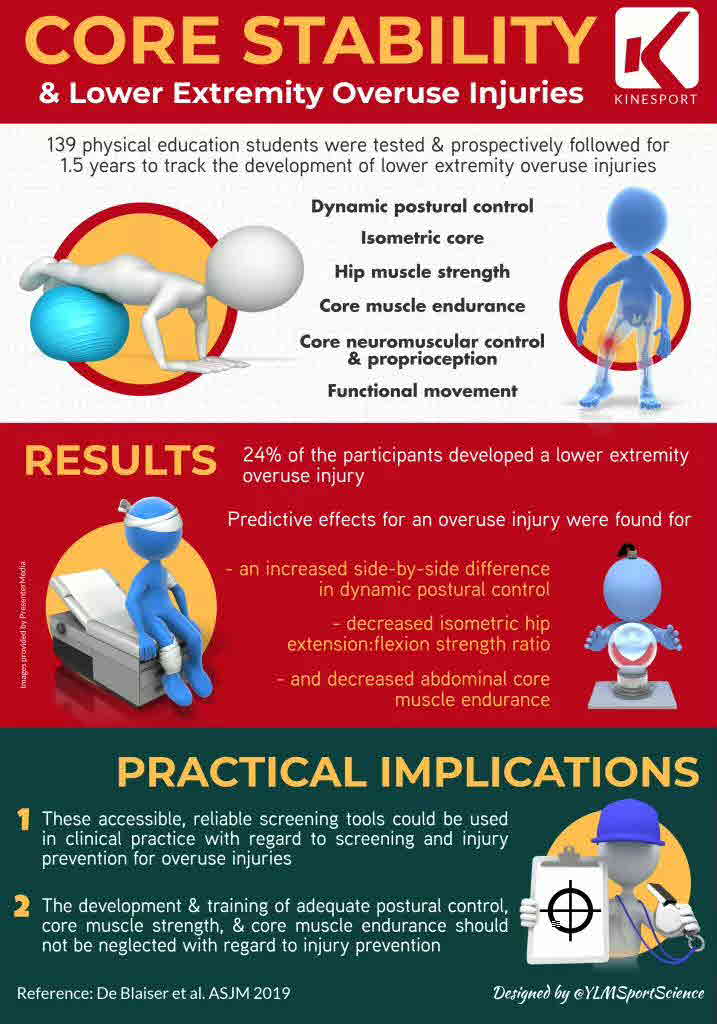
© Copyright 2019 YLMSportScience. Alle Rechte vorbehalten.
Background:Core stability has been suggested to influence lower extremity functioning and might contribute to the development of lower extremity overuse injuries. However, prospective studies to investigate this relationship are limited.Purpose:To research the role of different components of core stability as risk factors for the development of lower extremityoveruse injuries.Study Design:Cohort study; Level of evidence, 2.Methods:A total of 142 first-year physical education students participated in this study. They were tested in 2015 and were pro-spectively followed for 1.5 years by means of a multilevel injury registration method. Three participants were excluded owing tophysical complaints during testing. As such, 139 participants were included in the statistical analysis. At baseline, dynamic pos-tural control, isometric core and hip muscle strength, core muscle endurance, core neuromuscular control and proprioception,and functional movement were measured for all participants. Competing risk regression analyses were performed to identify sig-nificant contributors to the development of lower extremity overuse injuries.Results:During the follow-up period, 34 (24%) of the 139 participants developed a lower extremity overuse injury. Significantpredictive effects for an overuse injury were found for an increased side-by-side difference in dynamic postural control(P= .038), decreased isometric hip extension:flexion strength ratio (P= .046), and decreased abdominal core muscle endurance(P= .032).Conclusion:This study identified measures for dynamic postural control, core muscle strength, and core muscle endurance assignificant risk factors for the development of overuse injuries after statistical model building. However, core neuromuscular con-trol and proprioception and functional movement might not allow clinicians to identify patients at risk. These accessible, reliablescreening tools could be used in clinical practice with regard to screening and injury prevention for overuse injuries. Injury pre-diction based on this model needs to be done with caution given the low relative predictive accuracy (53%). Abstract from author
© Copyright 2019 The American Journal of Sports Medicine. SAGE Publications. Alle Rechte vorbehalten.
| Schlagworte: | |
|---|---|
| Notationen: | Biowissenschaften und Sportmedizin |
| Veröffentlicht in: | The American Journal of Sports Medicine |
| Sprache: | Englisch |
| Veröffentlicht: |
2019
|
| Online-Zugang: | https://journals.sagepub.com/doi/full/10.1177/0363546519837724 |
| Jahrgang: | 47 |
| Heft: | 7 |
| Seiten: | 1713-1721 |
| Dokumentenarten: | Artikel |
| Level: | hoch |