

Cow's milk as a post-exercise recovery drink: implications for performance and health
(Kuhmilch als Erholungsgetränk nach dem Training: Auswirkungen auf Leistung und Gesundheit)
© Copyright 2019 YLMSportScience. Alle Rechte vorbehalten.
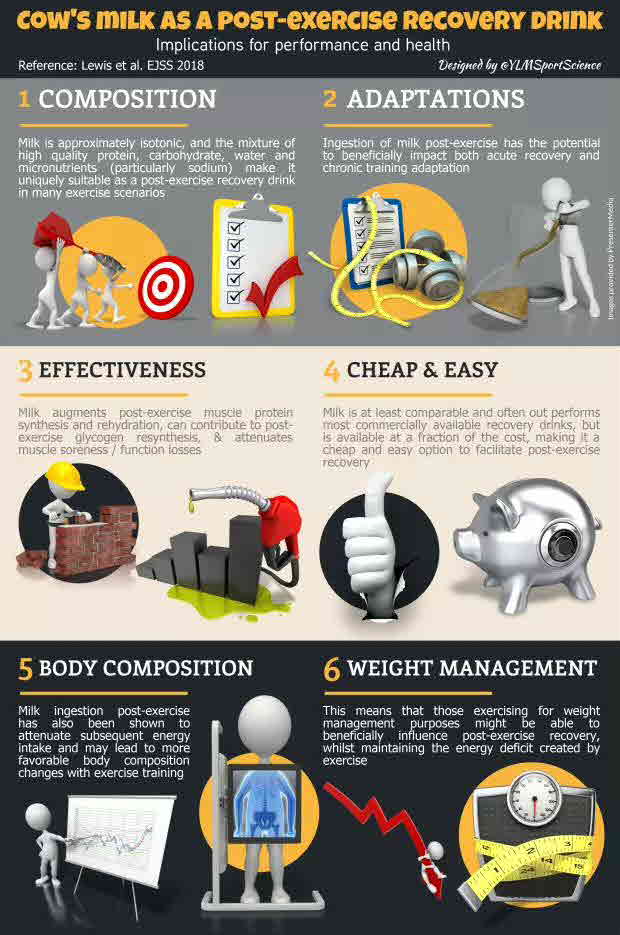
Post-exercise recovery is a multi-facetted process that will vary depending on the nature of the exercise, the time betweenexercise sessions and the goals of the exerciser. From a nutritional perspective, the main considerations are: (1)optimisation of muscle protein turnover; (2) glycogen resynthesis; (3) rehydration; (4) management of muscle soreness;(5) appropriate management of energy balance. Milk is approximately isotonic (osmolality of 280-290 mosmol/kg), andthe mixture of high quality protein, carbohydrate, water and micronutrients (particularly sodium) make it uniquelysuitable as a post-exercise recovery drink in many exercise scenarios. Research has shown that ingestion of milk post-exercise has the potential to beneficially impact both acute recovery and chronic training adaptation. Milk augments post-exercise muscle protein synthesis and rehydration, can contribute to post-exercise glycogen resynthesis, and attenuatespost-exercise muscle soreness/function losses. For these aspects of recovery, milk is at least comparable and often outperforms most commercially available recovery drinks, but is available at a fraction of the cost, making it a cheap and easyoption to facilitate post-exercise recovery. Milk ingestion post-exercise has also been shown to attenuate subsequentenergy intake and may lead to more favourable body composition changes with exercise training. This means that thoseexercising for weight management purposes might be able to beneficially influence post-exercise recovery, whilstmaintaining the energy deficit created by exercise. Abstract from author
© Copyright 2019 European Journal of Sport Science. Wiley. Alle Rechte vorbehalten.
| Schlagworte: | |
|---|---|
| Notationen: | Biowissenschaften und Sportmedizin |
| Veröffentlicht in: | European Journal of Sport Science |
| Sprache: | Englisch |
| Veröffentlicht: |
2019
|
| Online-Zugang: | https://www.tandfonline.com/doi/full/10.1080/17461391.2018.1534989 |
| Jahrgang: | 19 |
| Heft: | 1 |
| Seiten: | 40-48 |
| Dokumentenarten: | Artikel |
| Level: | hoch |