

The association of sport specialization and training volume with injury history in youth athletes
(Die Beziehung zwischen Spezialisierung im Sport und Trainingsumfang mit der Verletzungsgeschichte von jugendlichen Sportlern)
© Copyright 2017 YLMSportScience. Alle Rechte vorbehalten.
Background: Recommendations exist to encourage safe youth participation in sport. These recommendations include not specializing in 1 sport, limiting participation to less than 8 months per year, and limiting participation to fewer hours per week than a child`s age. However, limited evidence exists to support or refute these recommendations.
Hypothesis: High levels of specialization will be associated with a history of injuries and especially overuse injuries, independent of age, sex, or weekly sport training hours. Athletes who exceed current sport volume recommendations will be more likely to have a history of injuries and overuse injuries.
Study Design: Case-control study; Level of evidence, 3.
Methods: Youth athletes (n = 2011; 989 female and 1022 male; 12-18 years of age) completed a questionnaire regarding their specialization status, yearly and weekly sport participation volume, and injury history. Specialization was classified as low, moderate, or high using a previously utilized 3-point scale. Athletes were classified into groups based on either meeting or exceeding current volume recommendations (months per year and hours per week). Odds ratios (ORs) and 95% CIs were calculated to investigate associations of specialization and volume of participation with a history of sport-related injuries in the past year (P = .05).
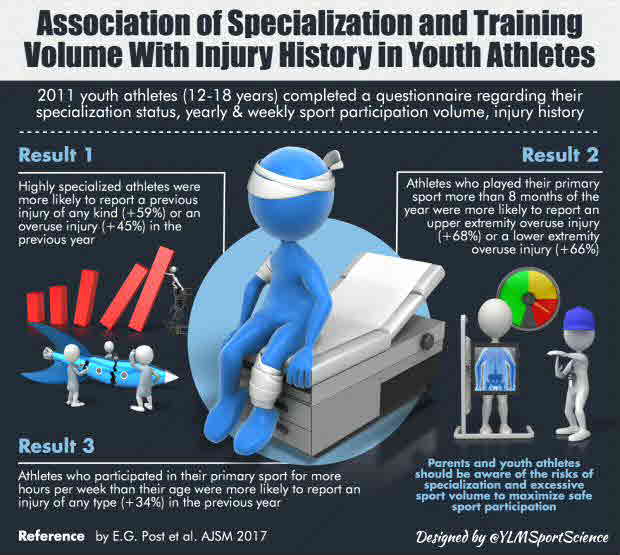
Results: Highly specialized athletes were more likely to report a previous injury of any kind (P < .001; OR, 1.59; 95% CI, 1.26-2.02) or an overuse injury (P = .011; OR, 1.45; 95% CI, 1.07-1.99) in the previous year compared with athletes in the low specialization group. Athletes who played their primary sport more than 8 months of the year were more likely to report an upper extremity overuse injury (P = .04; OR, 1.68; 95% CI, 1.06-2.80) or a lower extremity overuse injury (P = .001; OR, 1.66; 95% CI, 1.22-2.30). Athletes who participated in their primary sport for more hours per week than their age (ie, a 16-year-old athlete who participated in his or her primary sport for more than 16 h/wk) were more likely to report an injury of any type (P = .001; OR, 1.34; 95% CI, 1.12-1.61) in the previous year.
Conclusion: High levels of specialization were associated with a history of injuries, independent of age, sex, and weekly organized sport volume. Athletes who exceeded volume recommendations were more likely to have a history of overuse injuries.
Clinical Relevance: Parents and youth athletes should be aware of the risks of specialization and excessive sport volume to maximize safe sport participation.
© Copyright 2017 The American Journal of Sports Medicine. SAGE Publications. Alle Rechte vorbehalten.
| Schlagworte: | |
|---|---|
| Notationen: | Biowissenschaften und Sportmedizin Nachwuchssport Trainingswissenschaft |
| Veröffentlicht in: | The American Journal of Sports Medicine |
| Sprache: | Englisch |
| Veröffentlicht: |
2017
|
| Online-Zugang: | http://doi.org/10.1177/0363546517690848 |
| Jahrgang: | 45 |
| Heft: | 6 |
| Seiten: | 1405-1412 |
| Dokumentenarten: | Artikel |
| Level: | hoch |