

Recommendations and nutritional considerations for female athletes: Health and performance
(Empfehlungen und Ernährungshinweise für Sportlerinnen: Gesundheit und Leistung)
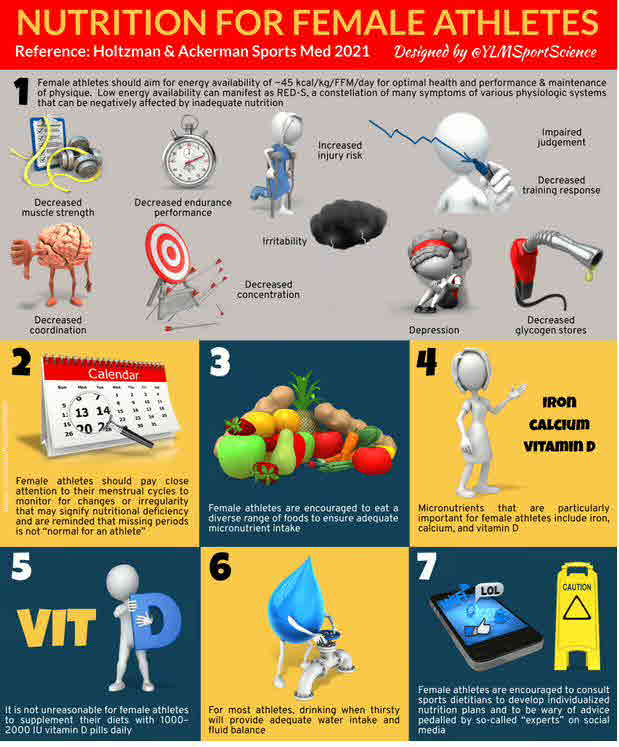
© Copyright 2021 YLMSportScience. Alle Rechte vorbehalten.
Optimal nutrition is an important aspect of an athlete`s preparation to achieve optimal health and performance. While general concepts about micro- and macronutrients and timing of food and fluids are addressed in sports science, rarely are the specific effects of women`s physiology on energy and fluid needs highly considered in research or clinical practice. Women differ from men not only in size, but in body composition and hormonal milieu, and also differ from one another. Their monthly hormonal cycles, with fluctuations in estrogen and progesterone, have varying effects on metabolism and fluid retention. Such cycles can change from month to month, can be suppressed with exogenous hormones, and may even be manipulated to capitalize on ideal timing for performance. But before such physiology can be manipulated, its relationship with nutrition and performance must be understood. This review will address general concepts regarding substrate metabolism in women versus men, common menstrual patterns of female athletes, nutrient and hydration needs during different phases of the menstrual cycle, and health and performance issues related to menstrual cycle disruption. We will discuss up-to-date recommendations for fueling female athletes, describe areas that require further exploration, and address methodological considerations to inform future work in this important area.
Key Points:
Female athletes should aim for energy availability (EA) of 45 kcal·kg-1 fat-free mass·day-1 for optimal health and performance; optimizing nutrient composition based on menstrual cycle phase is ineffective without the requisite energy for basic functioning.
Micronutrient deficiencies are common in female athletes, particularly in iron, vitamin D, and calcium; nutritional strategies should be used to prevent these deficiencies, including increasing consumption of diverse foods and potential supplementation.
Micro- and macronutrient requirements, as well as hydration needs, may change during various phases of the menstrual cycle as a result of hormonal fluctuations.
© Copyright 2021 Sports Medicine. Springer. Alle Rechte vorbehalten.
| Schlagworte: | |
|---|---|
| Notationen: | Biowissenschaften und Sportmedizin |
| Tagging: | RED-S Female Athlete Triad |
| Veröffentlicht in: | Sports Medicine |
| Sprache: | Englisch |
| Veröffentlicht: |
2021
|
| Online-Zugang: | https://link.springer.com/article/10.1007/s40279-021-01508-8 |
| Jahrgang: | 51 |
| Heft: | S1 |
| Seiten: | S43-S57 |
| Dokumentenarten: | Artikel |
| Level: | hoch |