

Low-carbohydrate training increases protein requirements of endurance athletes
(Kohlenhydratarmes Training erhöht den Proteinbedarf von Ausdauersportlern)
© Copyright 2019 YLMSportScience. Alle Rechte vorbehalten.
INTRODUCTION: Training with low-carbohydrate (CHO) availability enhances markers of aerobic adaptation and has become popular to periodize throughout an endurance-training program. However, exercise-induced amino acid oxidation is increased with low muscle glycogen, which may limit substrate availability for postexercise protein synthesis. We aimed to determine the impact of training with low-CHO availability on estimates of dietary protein requirements.
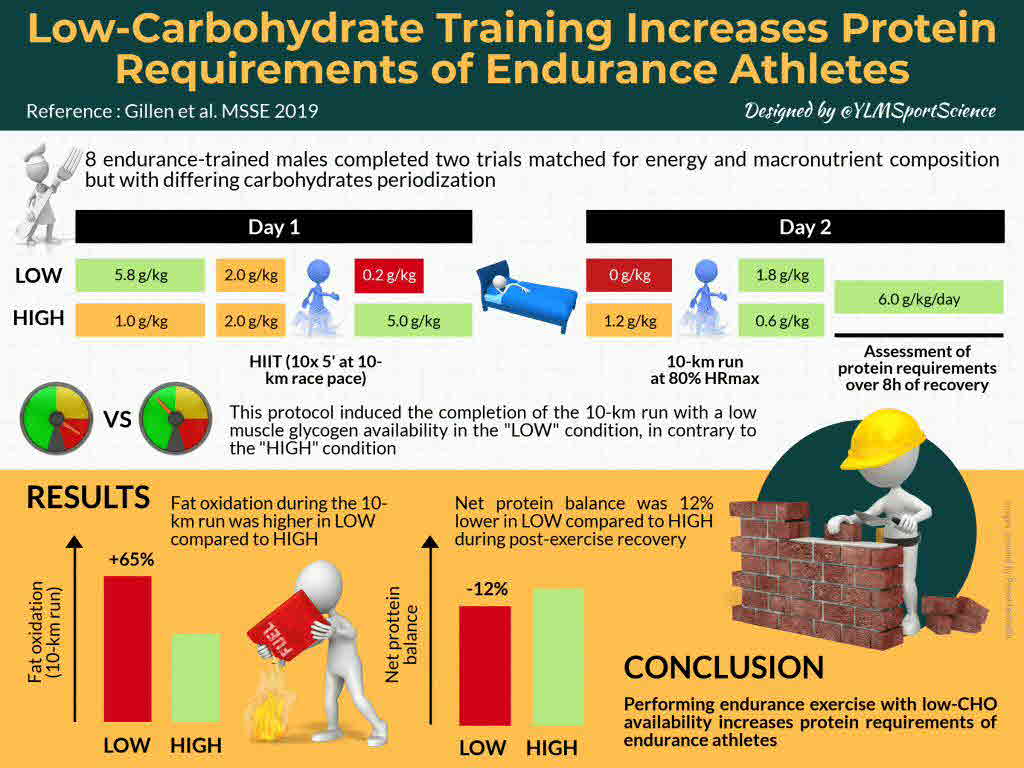
METHODS: Eight endurance-trained males (27 ± 4 yr, 75 ± 10 kg, 67 ± 10 mL·kg body mass·min) completed two trials matched for energy and macronutrient composition but with differing CHO periodization. In the low-CHO availability trial (LOW), participants consumed 7.8 g CHO·kg before evening high-intensity interval training (10 × 5 min at 10-km race pace, 1 min rest) and subsequently withheld CHO postexercise (0.2 g·kg). In the high-CHO availability trial (HIGH), participants consumed 3 g CHO·kg during the day before high-intensity interval training, and consumed 5 g CHO·kg that evening to promote muscle glycogen resynthesis. A 10-km run (~80% HRmax) was performed the following morning, fasted (LOW) or 1 h after consuming 1.2 g CHO·kg (HIGH). Whole-body phenylalanine flux and oxidation were determined over 8 h of recovery via oral [C]phenylalanine ingestion, according to standard indicator amino acid oxidation methodology, while consuming sufficient energy, 7.8 g CHO·kg·d, and suboptimal protein (0.93 g·kg·d).
RESULTS: Fat oxidation (indirect calorimetry) during the 10-km run was higher in LOW compared with HIGH (0.99 ± 0.35 g·min vs 0.60 ± 0.26 g·min, P < 0.05). phenylalanine flux during recovery was not different between trials (P > 0.05) whereas phenylalanine oxidation (reciprocal of protein synthesis) was higher in LOW compared with HIGH (8.8 ± 2.7 µmol·kg·h vs 7.9 ± 2.4 µmol·kg·h, P < 0.05), suggesting a greater amino acid requirement to support rates of whole-body protein synthesis.
CONCLUSIONS: Our findings suggest that performing endurance exercise with low-CHO availability increases protein requirements of endurance athletes.
© Copyright 2019 Medicine & Science in Sports & Exercise. Lippincott Williams & Wilkins. Alle Rechte vorbehalten.
| Schlagworte: | |
|---|---|
| Notationen: | Ausdauersportarten Biowissenschaften und Sportmedizin |
| Veröffentlicht in: | Medicine & Science in Sports & Exercise |
| Sprache: | Englisch |
| Veröffentlicht: |
2019
|
| Online-Zugang: | http://doi.org/10.1249/MSS.0000000000002036 |
| Jahrgang: | 51 |
| Heft: | 11 |
| Seiten: | 2294-2301 |
| Dokumentenarten: | Artikel |
| Level: | hoch |