

Sleep-related issues for recovery and performance in athletes
(Beziehung zwischen Schlaf und Regeneration und Leistung bei Sportlern)
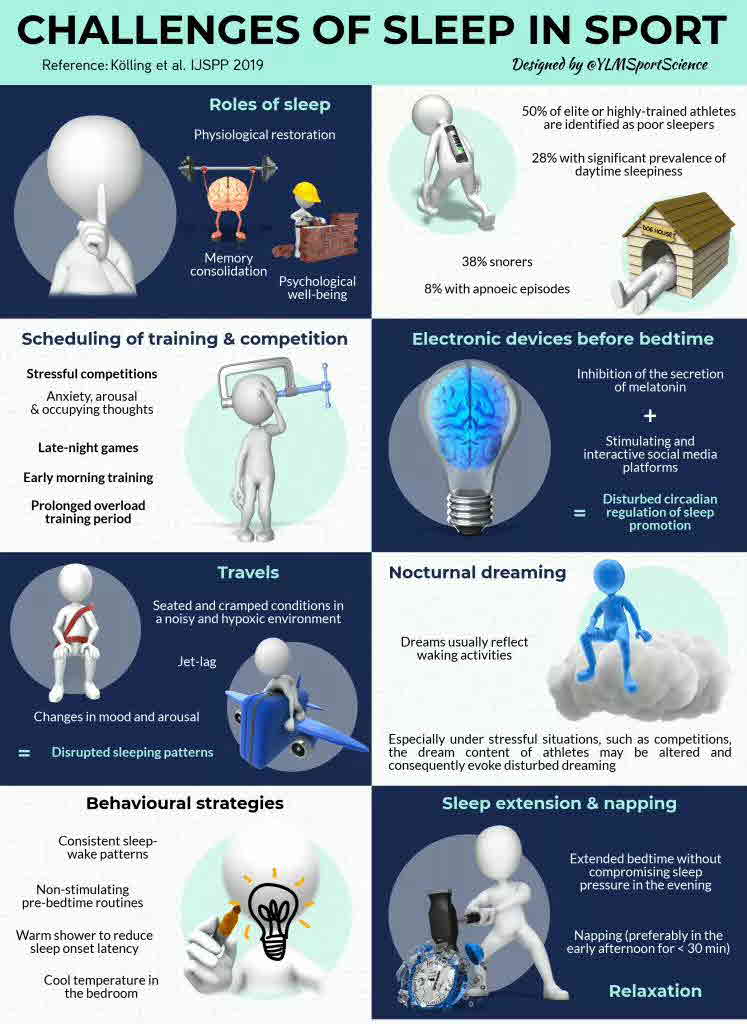
© Copyright 2019 YLMSportScience. Alle Rechte vorbehalten.
The body of research that reports the relevance of sleep in high-performance sports is growing steadily. While the identification of sleep cycles and diagnosis of sleep disorders are limited to lab-based assessment via polysomnography, the development of activity-based devices estimating sleep patterns provides greater insight into the sleep behavior of athletes in ecological settings. Generally, small sleep quantity and/or poor quality appears to exist in many athletic populations, although this may be related to training and competition context. Typical sleep-affecting factors are the scheduling of training sessions and competitions, as well as impaired sleep onset as a result of increased arousal prior to competition or due to the use of electronic devices before bedtime. Further challenges are travel demands, which may be accompanied by jet-lag symptoms and disruption of sleep habits. Promotion of sleep may be approached via behavioral strategies such as sleep hygiene, extending nighttime sleep, or daytime napping. Pharmacological interventions should be limited to clinically induced treatments, as evidence among healthy and athletic populations is lacking. To optimize and manage sleep in athletes, it is recommended to implement routine sleep monitoring on an individual basis.
© Copyright 2019 International Journal of Sports Physiology and Performance. Alle Rechte vorbehalten.
| Schlagworte: | |
|---|---|
| Notationen: | Biowissenschaften und Sportmedizin Trainingswissenschaft |
| Veröffentlicht in: | International Journal of Sports Physiology and Performance |
| Sprache: | Englisch |
| Veröffentlicht: |
2019
|
| Online-Zugang: | https://doi.org/10.1123/ijspp.2017-0746 |
| Jahrgang: | 14 |
| Heft: | 2 |
| Seiten: | 144-148 |
| Dokumentenarten: | Artikel |
| Level: | hoch |