

Considerations for ultra-endurance activities: part 1- nutrition
(Überlegungen zu Ultra-Ausdaueraktivitäten: Teil 1 - Ernährung)
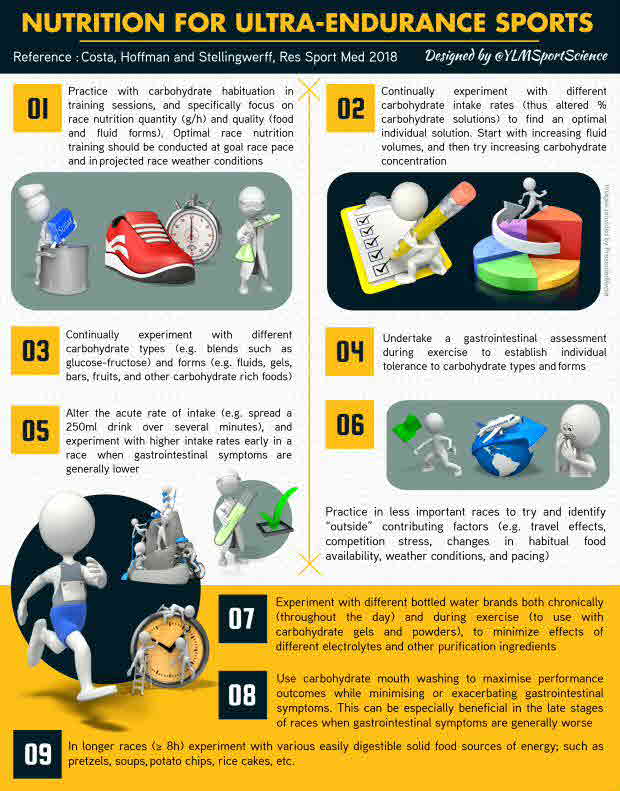
© Copyright 2019 YLMSportScience. Alle Rechte vorbehalten.
Ultra-endurance activities (>/-4h) present unique challenges that, beyond fatigue, may be exacerbated by sub-optimal nutrition during periods of increased requirements and compromised gastrointestinal function. The causes of fatigue during ultra-endurance exercise are multi-factorial. However, mechanisms can potentially include central or peripheral fatigue, thermal stress, dehydration, and/or endogenous glycogen store depletion; of which optimising nutrition and hydration can partially attenuate. If exercise duration is long enough (e.g. > /- 10h) and exercise intensity low enough (e.g. 45.60% of maximal oxygen uptake), it is bio-energetically plausible that ketogenic adaptation may enhance ultra-endurance performance, but this requires scientific substantiation. Conversely, the scientific literature has consistently demonstrated that daily dietary carbohydrates (3-12g/kg/day) and carbohydrate intake (30-110g/h) during ultra-endurance events can enhance performance at individually tolerable intake rates. Considering gastrointestinal symptoms are common in ultra-endurance activities, effective dietary prevention and management strategies may provide functional, histological, systemic, and symptomatic benefits. Taken together, a well-practiced and individualized fuelling approach is required to optimize performance in ultra-endurance events.
© Copyright 2019 Research in Sports Medicine. Taylor & Francis. Alle Rechte vorbehalten.
| Schlagworte: | |
|---|---|
| Notationen: | Ausdauersportarten Biowissenschaften und Sportmedizin |
| Tagging: | Ultraausdauersport |
| Veröffentlicht in: | Research in Sports Medicine |
| Sprache: | Englisch |
| Veröffentlicht: |
2019
|
| Online-Zugang: | https://www.tandfonline.com/doi/abs/10.1080/15438627.2018.1502188 |
| Jahrgang: | 29 |
| Heft: | 2 |
| Seiten: | 166-181 |
| Dokumentenarten: | Artikel |
| Level: | hoch |