

New strategies in sport nutrition to increase exercise performance
(Neue Strategien in der Sporternährung zur Steigerung der Bewegungsleistung)
© Copyright 2016 YLMSportScience. Alle Rechte vorbehalten.
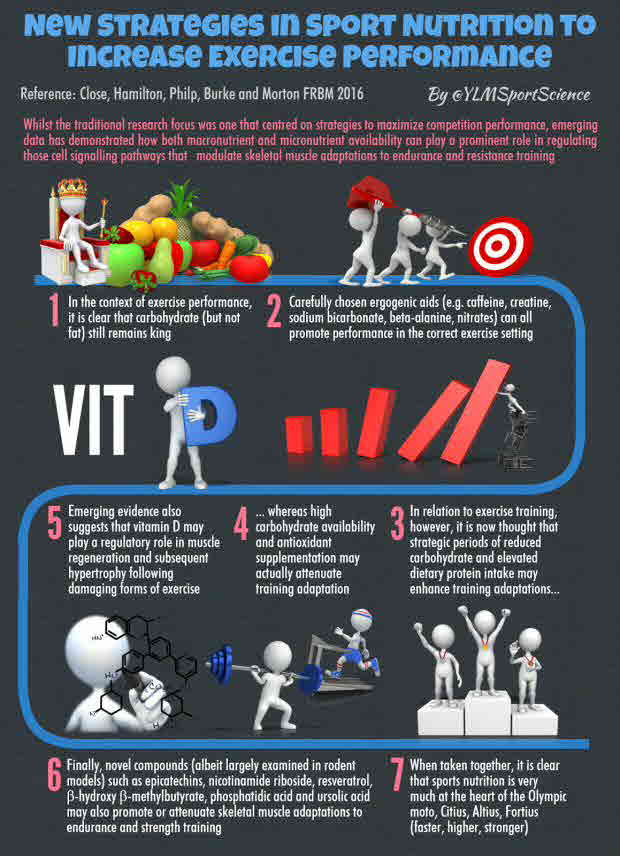
Despite over 50 years of research, the field of sports nutrition continues to grow at a rapid rate. Whilst the traditional research focus was one that centred on strategies to maximise competition performance, emerging data in the last decade has demonstrated how both macronutrient and micronutrient availability can play a prominent role in regulating those cell signalling pathways that modulate skeletal muscle adaptations to endurance and resistance training. Nonetheless, in the context of exercise performance, it is clear that carbohydrate (but not fat) still remains king and that carefully chosen ergogenic aids (e.g. caffeine, creatine, sodium bicarbonate, beta-alanine, nitrates) can all promote performance in the correct exercise setting. In relation to exercise training, however, it is now thought that strategic periods of reduced carbohydrate and elevated dietary protein intake may enhance training adaptations whereas high carbohydrate availability and antioxidant supplementation may actually attenuate training adaptation. Emerging evidence also suggests that vitamin D may play a regulatory role in muscle regeneration and subsequent hypertrophy following damaging forms of exercise. Finally, novel compounds (albeit largely examined in rodent models) such as epicatechins, nicotinamide riboside, resveratrol, ß-hydroxy ß-methylbutyrate, phosphatidic acid and ursolic acid may also promote or attenuate skeletal muscle adaptations to endurance and strength training. When taken together, it is clear that sports nutrition is very much at the heart of the Olympic motto,Citius, Altius, Fortius (faster, higher, stronger).
© Copyright 2016 Free Radical Biology and Medicine. Alle Rechte vorbehalten.
| Schlagworte: | |
|---|---|
| Notationen: | Biowissenschaften und Sportmedizin |
| Veröffentlicht in: | Free Radical Biology and Medicine |
| Sprache: | Englisch |
| Veröffentlicht: |
2016
|
| Online-Zugang: | http://doi.org/10.1016/j.freeradbiomed.2016.01.016 |
| Jahrgang: | 98 |
| Seiten: | 144-158 |
| Dokumentenarten: | Artikel |
| Level: | hoch |