

Jump-squat performance and its relationship with relative training intensity in high-level athletes
(Die Sprungkniebeuge-Leistung und ihr Zusammenhang zur relativen Trainingsintensität bei Sportlern im Spitzenbereich)
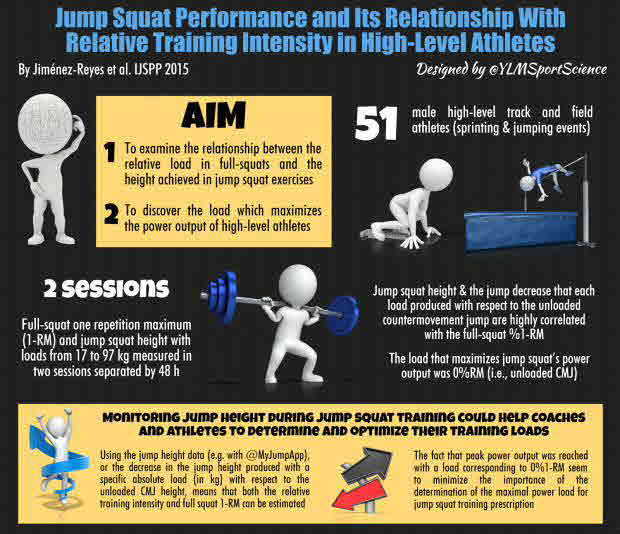
© Copyright 2015 YLMSportScience. Alle Rechte vorbehalten.
Purpose: To examine the relationship between the relative load in full squats and the height achieved in jump-squat (JS) exercises and to determine the load that maximizes the power output of high-level athletes. Method: Fifty-one male high-level track-and-field athletes (age 25.2 ± 4.4 y, weight 77. ± 6.2 kg, height 179.9 ± 5.6 cm) who competed in sprinting and jumping events took part in the study. Full-squat 1-repetition-maximum (1-RM) and JS height (JH) with loads from 17 to 97 kg were measured in 2 sessions separated by 48 h. Results: Individual regression analyses showed that JH (R2 = .992 ± .005) and the jump decrease (JD) that each load produced with respect to the unloaded countermovement jump (CMJ) (R2 = .992 ± 0.007) are highly correlated with the full-squat %1-RM, which means that training intensities can be prescribed using JH and JD values. The authors also found that the load that maximizes JS`s power output was 0%RM (ie, unloaded CMJ). Conclusions: These results highlight the close relationship between JS performance and relative training intensity in terms of %1-RM. The authors also observed that the load that maximizes power output was 0%1-RM. Monitoring jump height during JS training could help coaches and athletes determine and optimize their training loads.
© Copyright 2015 International Journal of Sports Physiology and Performance. Alle Rechte vorbehalten.
| Schlagworte: | |
|---|---|
| Notationen: | Trainingswissenschaft |
| Veröffentlicht in: | International Journal of Sports Physiology and Performance |
| Sprache: | Englisch |
| Veröffentlicht: |
2015
|
| Online-Zugang: | http://doi.org/10.1123/ijspp.2014-0545 |
| Jahrgang: | 10 |
| Heft: | 8 |
| Seiten: | 1036-1040 |
| Dokumentenarten: | Artikel |
| Level: | hoch |