

The metabolic adatations to endurance training
(Die metabolische Anpassung an Ausdauertraining)
© Copyright 2012 YLMSportScience. Alle Rechte vorbehalten.
Summary
With increasing understanding of the adaptive processes to endurance exercise, training techniques have become more effectively tailored to optimise gains in endurance performance.
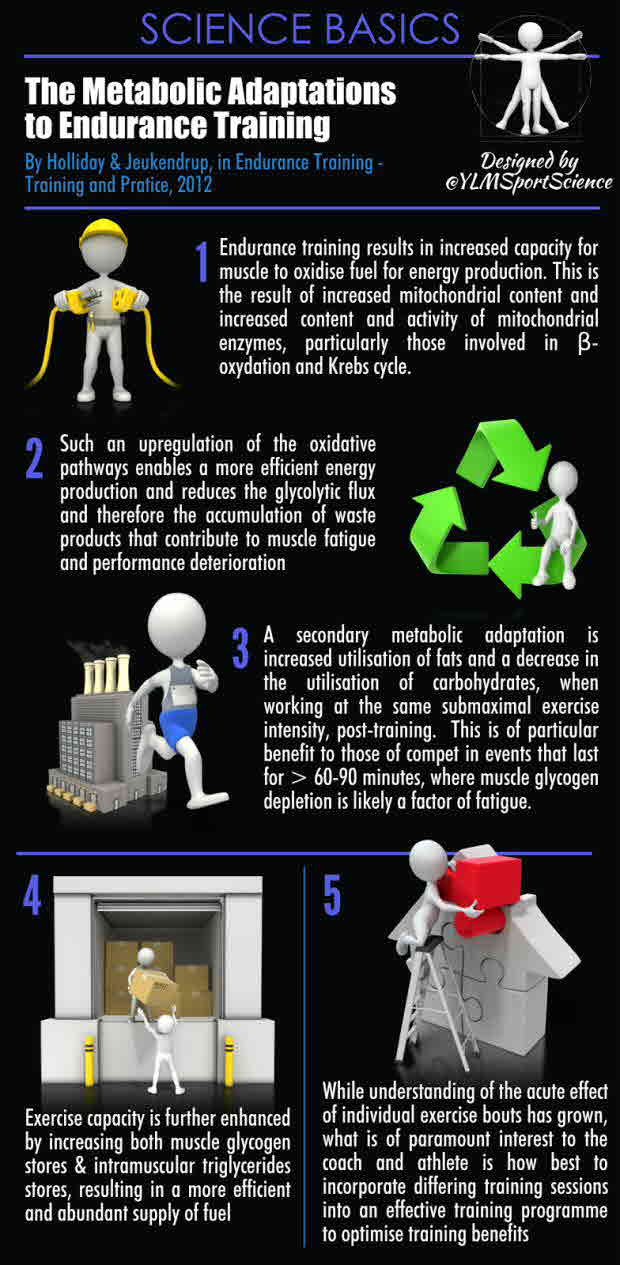
• Endurance training results in an increased capacity for skeletal muscle to oxidise fuel for energy production.
• This is a result of increased mitochondrial content and increased content and activity of mitochondrial enzymes, particularly those involved in (3-oxidation and the TCA-cyle.
• Increased flux of both systems results in a greater production of electrons for the electron-transport chain and hence, oxidative phosphorylation is upregulated. Such an upregulation of the oxidative pathways enables a more efficient energy production and reduces the glycolitic flux and therefore the accumulation of waste products that contribute to muscle fatigue and performance deterioration.
• A secondary metabolic adaptation is an increased utilisation of fats and a decrease in the utilisation of carbohydrates, when working at the same submaximal exercise intensity, post-training. This results in a muscle glycogen sparing effect, attenuating muscle glycogen depletion during prolonged submaximal exercise.
• This is of particular benefit to those who compete in events that last for > 60-90 minutes, where muscle glycogen depletion is likely a factor for fatigue.
• Exercise capacity is further enhanced by increasing both muscle glycogen stores and IMTG stores, resulting in a more efficient and abundant supply of fuel.
• Perhaps future research should pursue two distinct avenues: firstly, the importance of exercise duration and training volume for transcription factor perturbations and hence metabolic adaptations should be investigated; secondly, it is necessary to identify patterns of training that elicit the greatest adaptations and hence the greatest endurance performance benefits.
• While understanding of the acute effect of individual exercise bouts has grown, what is of paramount interest to the coach and athlete is how best to incorporate differing training sessions into an effective training programme to optimise training benefits.
• Further acute exercise and training interventions should be investigated for this purpose.
© Copyright 2012 Endurance Training - Science and Practice. Veröffentlicht von Inigo Mujika. Alle Rechte vorbehalten.
| Schlagworte: | |
|---|---|
| Notationen: | Ausdauersportarten Biowissenschaften und Sportmedizin |
| Veröffentlicht in: | Endurance Training - Science and Practice |
| Sprache: | Englisch |
| Veröffentlicht: |
Vitoria-Gasteiz
Inigo Mujika
2012
|
| Seiten: | 141-152 |
| Dokumentenarten: | Artikel |
| Level: | hoch |