

Unskilled and unaware of it: How difficulties in recognizing one's own incompetence lead to inflated self-assessments
© Copyright 1999 YLMSportScience. All rights reserved.
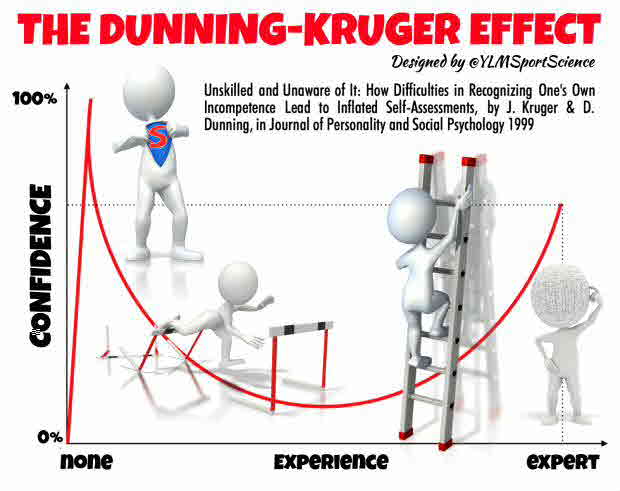
People tend to hold overly favorable views of their abilities in many social and intellectual domains. The authors suggest that this overestimation occurs, in part, because people who are unskilled in these domains suffer a dual burden: Not only do these people reach erroneous conclusions and make unfortunate choices, but their incompetence robs them of the metacognitive ability to realize it. Across 4 studies, the authors found that participants scoring in the bottom quartile on tests of humor, grammar, and logic grossly overestimated their test performance and ability. Although their test scores put them in the 12th percentile, they estimated themselves to be in the 62nd. Several analyses linked this miscalibration to deficits in metacognitive skill, or the capacity to distinguish accuracy from error. Paradoxically, improving the skills of the participants, and thus increasing their metacognitive competence, helped them recognize the limitations of their abilities.
siehe auch: https://ylmsportscience.com/2017/04/24/the-dunning-kruger-effect-how-difficulties-in-recognizing-ones-own-incompetence-lead-to-inflated-self-assessments/
© Copyright 1999 Journal of Personality and Social Psychology. American Psychological Association. All rights reserved.
| Subjects: | |
|---|---|
| Notations: | social sciences |
| Tagging: | Selbstbewertung |
| Published in: | Journal of Personality and Social Psychology |
| Language: | English |
| Published: |
1999
|
| Online Access: | http://doi.org/10.1037/0022-3514.77.6.1121 |
| Volume: | 77 |
| Issue: | 6 |
| Pages: | 1121-1134 |
| Document types: | article |
| Level: | advanced |