

Performance psychology: Perception, action, cognition, and emotion
(Performance-Psychologie: Wahrnehmung, Aktion, Kognition und Emotion)
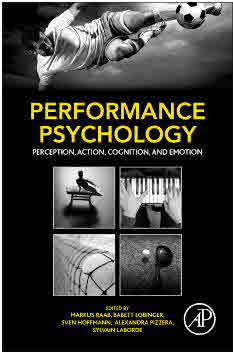
This book integrates findings from across domains in performance psychology to focus on core research on what influences peak and non-peak performance. The book explores basic and applied research identifying cognition-action interactions, perception-cognition interactions, emotion-cognition interactions, and perception-action interactions. The book explores performance in sports, music, and the arts both for individuals and teams/groups, looking at the influence of cognition, perception, personality, motivation and drive, attention, stress, coaching, and age. This comprehensive work includes contributions from the US, UK, Canada, Germany, and Australia.
Section A. What is Performance Psychology?
Chapter 1. The Building Blocks of Performance: An Overview: Perception; Action; Cognition; Emotion
Chapter 2. Theoretical Framework of Performance Psychology: An Action Theory Perspective; Definition and Scope of Performance Psychology; Conclusion
Chapter 3. Measurement Considerations in Performance Psychology: Measurement Considerations in Performance Psychology; Types of Measures; Measurement and Theory Development; Two-Parameter Model for Capturing the Cognitive-Affective-Behavioral Linkage in Performance Psychology; New Trends in Performance Measurement; Summary
Chapter 4. Applications within Performance Psychology: Functions of Applied Performance Psychology; The Road to Excellence; Developing an Ecologically Appropriate Performance Psychology Program in Music; Considerations for Implementing Performance Psychology; Conclusion
Section B. Performance Phenomena of Cognitive-Action Interaction
Chapter 5. Bridging the Gap between Action and Cognition: An Overview: Cognition and Action; The Yips in Golf; The Education of Soccer Coaches; Talent Identification and Assessment in High-Performance Sports; Conclusion
Chapter 6. Improving Performance by Means of Action-Cognition Coupling in Athletes and Coaches: The Profession of Coaching; Purpose; Development of Coaching Expertise; Athlete Perceptions of Successful Coaching; Expectancy Effects in Competitive Sport; Summary and Conclusion
Chapter 7. Music Performance: Expectations; Failures; and Prevention; Communalities and Differences between Sports and Music Performance; Performance Failures in Musicians; Improving Performance in Musicians; A Heuristic Model of Performance Failures in Musicians; Conclusion: Some Implications for Prevention
Chapter 8. Motor Imagery and Mental Training in Older Adults: Motor Imagery as a Prerequisite for Mental Training; Motor Imagery and Mental Training in Older Adults; Mental Balance Training for Postural Control; Conclusion and Future Research
Section C. Dysfunctional Learning; Errors; and Other Performance Phenomena of Perception-Cognition Interactions
Chapter 9. Bridging the Gap between Perception and Cognition: An Overview; Neurophysiological Implementation of Cognitive Mechanisms Guiding Perception and Action; Cognitive Models: Drift Diffusion; Conclusion and Outlook
Chapter 10. Performance and Error Monitoring: Causes and Consequences: Theories of Error Processing; Methodological Issues When Measuring Response-Related EEG Activity; Predicting Errors; Conclusion
Chapter 11. Committing Errors as a Consequence of an Adverse Focus of Attention: "Serious" Errors in the Course of Perception; Selective Attention as Biased Competition; Selective Attention and Change Blindness; Perceptual Errors under Conditions of Inattention; Selective Attention and Visual Awareness; Conclusion
Chapter 12. Lifestyle and Interventions for Improving Cognitive Performance in Older Adults: Cognitive Leisure Activity; Conclusion
Section D. Self-Other Perceptions and Other Performance Phenomena of Perception- Action Interactions
Chapter 13. Bridging the Gap between Perception and Action: An Overview: How Does Perception Affect Action? How Does Action Affect Perception? Online and Offline Effects of the Perception-Action Link; Conclusion and Future Research
Chapter 14. Capturing Motion for Enhancing Performance: An Embodied Cognition Perspective on Sports and the Performing Arts: Overview of Theoretical Approaches; Overview of Empirical Research; Conclusion
Chapter 15. Auditory Action Perception: Auditory Perception; Auditory Action Perception; Bidirectional Action Perception Coupling; Internal Model and Reafferences; Empirical Evidence; Conclusion and Future Research
Chapter 16. Visual Perception in Expert Action: State of Research; Applied Science: The Visual Control of Basketball Shooting; Future Research
Section E. Performance under Pressure of Individuals or Teams and Other Performance Phenomena of Emotion-Cognition Interactions: Introduction; Overview
Chapter 17. Bridging the Gap between Emotion and Cognition: An Overview; Emotions and Other Affective Phenomena; Cognition: A Necessary Distinction Between Executive and Non-Executive Functions; Performance-Oriented Theories Bridging the Gap between Emotion and Cognition; Conclusion
Chapter 18. Performing under Pressure: Influence of Personality-Trait-Like Individual Differences: PTLIDs and the Influence on Performance under Pressure; Future Research Directions within PTLID Research; The Blanket Approach: Guidelines for Use and Concluding Remarks
Chapter 19. The Influence of Hormonal Stress on Performance: Instructions for Getting Your Dream Job Based on Cortisol Research; Cortisol-What Is It and What Does It Do? State and Trait Influences on Cortisol; Cortisol and Performance; Cortisol-Performance Framework; Summary and Outlook
Chapter 20. Performing under Pressure: High-Level Cognition in High-Pressure Environments: Problem Solving; Creativity; Decision-Making; Comparing Problem Solving and Creativity; Comparing Decision-Making and Problem Solving/Creativity; Emotional Influence on Higher Cognition; Conclusion and Directions for Future Research
© Copyright 2016 Veröffentlicht von Elsevier. Alle Rechte vorbehalten.
| Schlagworte: | |
|---|---|
| Notationen: | Biowissenschaften und Sportmedizin Sozial- und Geisteswissenschaften |
| Sprache: | Englisch |
| Veröffentlicht: |
London
Elsevier
2016
|
| Seiten: | 348 |
| Dokumentenarten: | Buch |
| Level: | hoch |