



Influence of resistance training proximity-to-failure on skeletal muscle hypertrophy: a systematic review with meta-analysis
(Einfluss des Widerstandstrainings in der Nähe des Versagens auf die Skelettmuskelhypertrophie: eine systematische Überprüfung mit Metaanalyse)
© Copyright 2023 YLMSportScience. Alle Rechte vorbehalten.
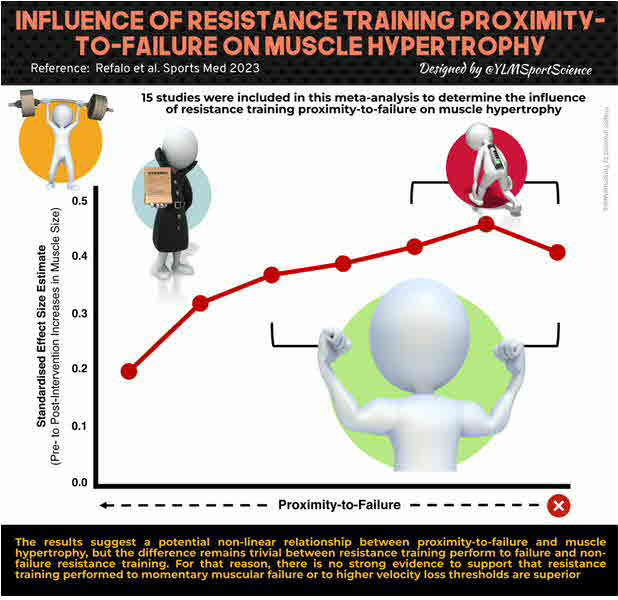
Background and Objective: This systematic review with meta-analysis investigated the influence of resistance training proximity-to-failure on muscle hypertrophy.
Methods: Literature searches in the PubMed, SCOPUS and SPORTDiscus databases identified a total of 15 studies that measured muscle hypertrophy (in healthy adults of any age and resistance training experience) and compared resistance training performed to: (A) momentary muscular failure versus non-failure; (B) set failure (defined as anything other than momentary muscular failure) versus non-failure; or (C) different velocity loss thresholds.
Results: There was a trivial advantage for resistance training performed to set failure versus non-failure for muscle hypertrophy in studies applying any definition of set failure [effect size=0.19 (95% confidence interval 0.00, 0.37), p=0.045], with no moderating effect of volume load (p=0.884) or relative load (p=0.525). Given the variability in set failure definitions applied across studies, sub-group analyses were conducted and found no advantage for either resistance training performed to momentary muscular failure versus non-failure for muscle hypertrophy [effect size=0.12 (95% confidence interval -0.13, 0.37), p=0.343], or for resistance training performed to high (>25%) versus moderate (20-25%) velocity loss thresholds [effect size=0.08 (95% confidence interval -0.16, 0.32), p=0.529].
Conclusion: Overall, our main findings suggest that (i) there is no evidence to support that resistance training performed to momentary muscular failure is superior to non-failure resistance training for muscle hypertrophy and (ii) higher velocity loss thresholds, and theoretically closer proximities-to-failure do not always elicit greater muscle hypertrophy. As such, these results provide evidence for a potential non-linear relationship between proximity-to-failure and muscle hypertrophy.
© Copyright 2023 Sports Medicine. Springer. Alle Rechte vorbehalten.
| Schlagworte: | |
|---|---|
| Notationen: | Trainingswissenschaft Biowissenschaften und Sportmedizin |
| Tagging: | Hypertrophie |
| Veröffentlicht in: | Sports Medicine |
| Sprache: | Englisch |
| Veröffentlicht: |
2023
|
| Online-Zugang: | https://doi.org/10.1007/s40279-022-01784-y |
| Jahrgang: | 53 |
| Heft: | 3 |
| Seiten: | 649-665 |
| Dokumentenarten: | Artikel |
| Level: | hoch |