



Just how confident can we be in predicting sports injuries? A systematic review of the methodological conduct and performance of existing musculoskeletal injury prediction models in sport
(Wie sicher können wir Sportverletzungen vorhersagen? Ein systematischer Überblick über die methodische Vorgehensweise und die Leistungsfähigkeit bestehender Modelle zur Vorhersage von Muskel-Skelett-Verletzungen im Sport)
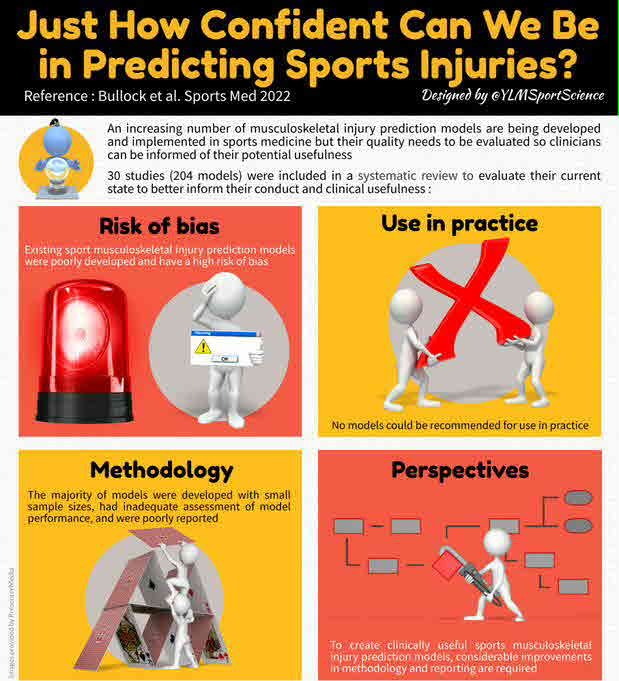
© Copyright 2022 YLMSportScience. Alle Rechte vorbehalten.
Background: An increasing number of musculoskeletal injury prediction models are being developed and implemented in sports medicine. Prediction model quality needs to be evaluated so clinicians can be informed of their potential usefulness.
Objective: To evaluate the methodological conduct and completeness of reporting of musculoskeletal injury prediction models in sport.
Methods: A systematic review was performed from inception to June 2021. Studies were included if they: (1) predicted sport injury; (2) used regression, machine learning, or deep learning models; (3) were written in English; (4) were peer reviewed.
Results: Thirty studies (204 models) were included; 60% of studies utilized only regression methods, 13% only machine learning, and 27% both regression and machine learning approaches. All studies developed a prediction model and no studies externally validated a prediction model. Two percent of models (7% of studies) were low risk of bias and 98% of models (93% of studies) were high or unclear risk of bias. Three studies (10%) performed an a priori sample size calculation; 14 (47%) performed internal validation. Nineteen studies (63%) reported discrimination and two (7%) reported calibration. Four studies (13%) reported model equations for statistical predictions and no machine learning studies reported code or hyperparameters.
Conclusion: Existing sport musculoskeletal injury prediction models were poorly developed and have a high risk of bias. No models could be recommended for use in practice. The majority of models were developed with small sample sizes, had inadequate assessment of model performance, and were poorly reported. To create clinically useful sports musculoskeletal injury prediction models, considerable improvements in methodology and reporting are urgently required.
© Copyright 2022 Sports Medicine. Springer. Alle Rechte vorbehalten.
| Schlagworte: | |
|---|---|
| Notationen: | Biowissenschaften und Sportmedizin Naturwissenschaften und Technik |
| Tagging: | deep learning maschinelles Lernen Regressionsanalyse |
| Veröffentlicht in: | Sports Medicine |
| Sprache: | Englisch |
| Veröffentlicht: |
2022
|
| Online-Zugang: | https://doi.org/10.1007/s40279-022-01698-9 |
| Jahrgang: | 52 |
| Heft: | 10 |
| Seiten: | 2469-2482 |
| Dokumentenarten: | Artikel |
| Level: | hoch |