



Higher- versus lower-intensity strength-training taper: Effects on neuromuscular performance
(Tapering des Krafttrainings mit höherer vs. niedrigerer Intensität: Auswirkungen auf die neuromuskuläre Leistung)
© Copyright 2019 YLMSportScience. Alle Rechte vorbehalten.
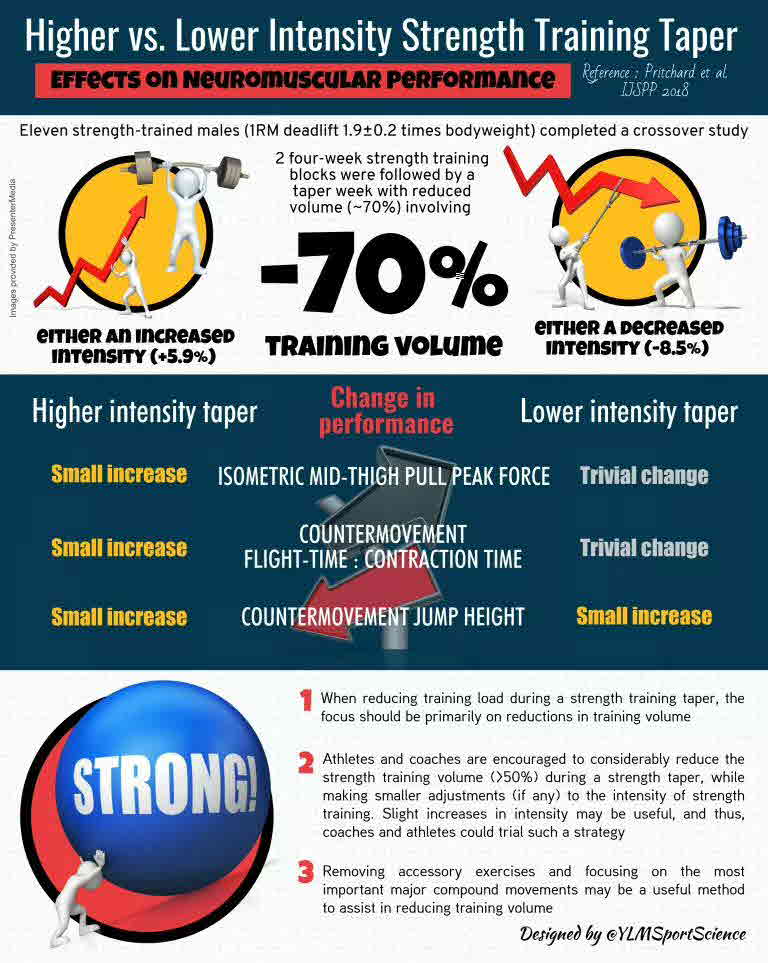
Purpose: To investigate the effects of strength-training tapers of different intensities but equal volume reductions on neuromuscular performance. Methods: Eleven strength-trained men (21.3 [3.3] y, 92.3 [17.6] kg, relative 1-repetition-maximum deadlift 1.9 [0.2] times bodyweight) completed a crossover study. Specifically, two 4-wk strength-training blocks were followed by a taper week with reduced volume (~70%) involving either increased (5.9%) or decreased (-8.5%) intensity. Testing occurred pretraining (T1), posttraining (T2), and posttaper (T3). Salivary testosterone and cortisol, plasma creatine kinase, a Daily Analysis of Life Demands in Athletes questionnaire, countermovement jump (CMJ), isometric midthigh pull, and isometric bench press were measured. Results: CMJ height improved significantly over time (P < .001), with significant increases from T1 (38.0 [5.5] cm) to both T2 (39.3 [5.3] cm; P = .010) and T3 (40.0 [5.3] cm; P = .001) and from T2 to T3 (P = .002). CMJ flight time:contraction time increased significantly over time (P = .004), with significant increases from T1 (0.747 [0.162]) to T2 (0.791 [0.163]; P = .012). Isometric midthigh-pull relative peak force improved significantly over time (P = .033), with significant increases from T1 (34.7 [5.0] N/kg) to T2 (35.9 [4.8] N/kg; P = .013). No significant changes were found between tapers. However, the higher-intensity taper produced small effect-size increases at T3 vs T1 for isometric midthigh-pull relative peak force, CMJ height, and flight time:contraction time, while the lower-intensity taper only produced small effect-size improvements at T3 vs T1 for CMJ height. Conclusions: A strength-training taper with volume reductions had a positive effect on power, with a tendency for the higher-intensity taper to produce more favorable changes in strength and power.
© Copyright 2019 International Journal of Sports Physiology and Performance. Alle Rechte vorbehalten.
| Schlagworte: | |
|---|---|
| Notationen: | Trainingswissenschaft |
| Veröffentlicht in: | International Journal of Sports Physiology and Performance |
| Sprache: | Englisch |
| Veröffentlicht: |
2019
|
| Online-Zugang: | https://doi.org/10.1123/ijspp.2018-0489 |
| Jahrgang: | 14 |
| Heft: | 4 |
| Seiten: | 458-463 |
| Dokumentenarten: | Artikel |
| Level: | hoch |