



Are prepubertal children metabolically comparable to well-trained adult endurance athletes?
(Sind Kinder im präpuberalen Stadium stoffwechselseitig mit gut trainierten Ausdauersportlern im Erwachsenenalter vergleichbar?)
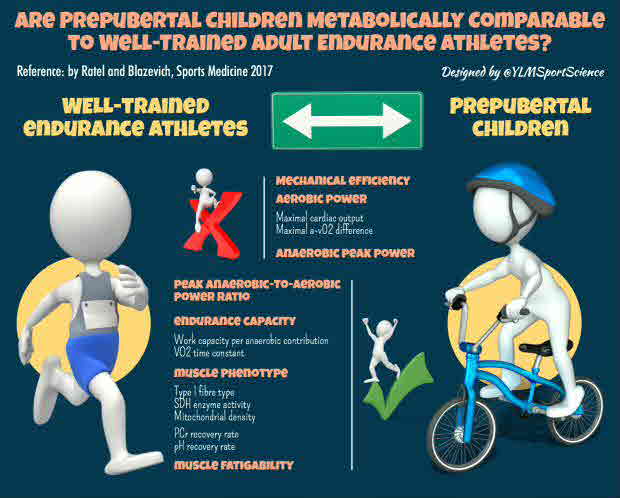
© Copyright 2017 YLMSportScience. Alle Rechte vorbehalten.
It is well acknowledged that prepubertal children have smaller body dimensions and a poorer mechanical (movement) efficiency, and thus a lower work capacity than adults. However, the scientific evidence indicates that prepubertal children have a greater net contribution of energy derived from aerobic metabolism in exercising muscle and reduced susceptibility to muscular fatigue, which makes them metabolically comparable to well-trained adult endurance athletes. For example, the relative energy contribution from oxidative and non-oxidative (i.e. anaerobic) sources during moderate-to-intense exercise, the work output for a given anaerobic energy contribution and the rate of acceleration of aerobic metabolic machinery in response to submaximal exercise are similar between prepubertal children and well-trained adult endurance athletes. Similar conclusions can be drawn on the basis of experimental data derived from intra-muscular measurements such as type I fibre percentage, succinate dehydrogenase enzyme activity, mitochondrial volume density, post-exercise phosphocreatine re-synthesis rate and muscle by-product clearance rates (i.e. H+ ions). On a more practical level, prepubertal children also experience similar decrements in peak power output as well-trained adult endurance athletes during repeated maximal exercise bouts. Therefore, prepubertal children have a comparable relative oxidative contribution to well-trained adult endurance athletes, but a decrease in this relative contribution occurs from childhood through to early adulthood. In a clinical context, this understanding may prove central to the development of exercise-based strategies for the prevention and treatment of many metabolic diseases related to mitochondrial oxidative dysfunction (e.g. in obese, insulin-resistant and diabetic patients), which are often accompanied by muscular deconditioning during adolescence and adulthood.
© Copyright 2017 Sports Medicine. Springer. Alle Rechte vorbehalten.
| Schlagworte: | |
|---|---|
| Notationen: | Ausdauersportarten Biowissenschaften und Sportmedizin Nachwuchssport |
| Veröffentlicht in: | Sports Medicine |
| Sprache: | Englisch |
| Veröffentlicht: |
2017
|
| Online-Zugang: | https://doi.org/10.1007/s40279-016-0671-1 |
| Jahrgang: | 47 |
| Heft: | 8 |
| Seiten: | 1477-1485 |
| Dokumentenarten: | Artikel |
| Level: | hoch |