



Effect of training leading to repetition failure on muscular strength: A systematic review and meta-analysis
(Die Auswirkung von Training bis zu einem Zustand, dass keine Übungswiederholung mehr bewältigt wird, auf die muskuläre Kraft: Ein systematischer Überblick und Meta-Analyse)
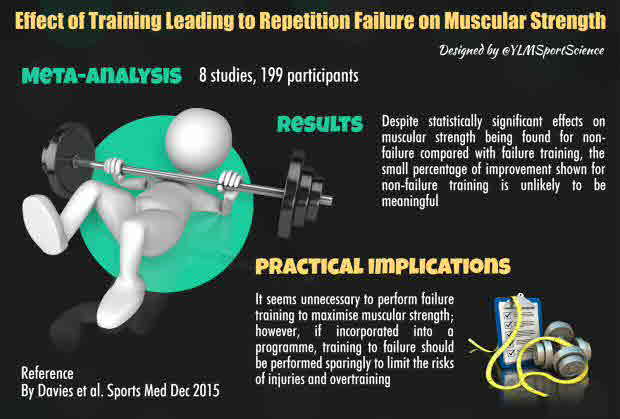
© Copyright 2016 YLMSportScience. Alle Rechte vorbehalten.
It remains unclear whether repetitions leading to failure (failure training) or not leading to failure (non-failure training) lead to superior muscular strength gains during resistance exercise. Failure training may provide the stimulus needed to enhance muscular strength development. However, it is argued that non-failure training leads to similar increases in muscular strength without the need for high levels of discomfort and physical effort, which are associated with failure training.
Objective: We conducted a systematic review and meta-analysis to examine the effect of failure versus non-failure training on muscular strength.
Methods: Five electronic databases were searched using terms related to failure and non-failure training. Studies were deemed eligible for inclusion if they met the following criteria: (1) randomised and non-randomised studies; (2) resistance training intervention where repetitions were performed to failure; (3) a non-failure comparison group; (4) resistance training interventions with a total of =3 exercise sessions; and (5) muscular strength assessment pre- and post-training. Random-effects meta-analyses were performed to pool the results of the included studies and generate a weighted mean effect size (ES).
Results: Eight studies were included in the meta-analysis (combined studies). Training volume was controlled in four studies (volume controlled), while the remaining four studies did not control for training volume (volume uncontrolled). Non-failure training resulted in a 0.6-1.3 % greater strength increase than failure training. A small pooled effect favouring non-failure training was found (ES = 0.34; p = 0.02). Significant small pooled effects on muscular strength were also found for non-failure versus failure training with compound exercises (ES = 0.37-0.38; p = 0.03) and trained participants (ES = 0.37; p = 0.049). A slightly larger pooled effect favouring non-failure training was observed when volume-uncontrolled studies were included (ES = 0.41; p = 0.047). No significant effect was found for the volume-controlled studies, although there was a trend favouring non-failure training. The methodological quality of the included studies in the review was found to be moderate. Exercise compliance was high for the studies where this was reported (n = 5), although limited information on adverse events was provided.
Conclusion: Overall, the results suggest that despite statistically significant effects on muscular strength being found for non-failure compared with failure training, the small percentage of improvement shown for non-failure training is unlikely to be meaningful. Therefore, it appears that similar increases in muscular strength can be achieved with failure and non-failure training. Furthermore, it seems unnecessary to perform failure training to maximise muscular strength; however, if incorporated into a programme, training to failure should be performed sparingly to limit the risks of injuries and overtraining.
Volltext auch unter: https://www.researchgate.net/publication/287159026_Effect_of_Training_Leading_to_Repetition_Failure_on_Muscular_Strength_A_Systematic_Review_and_Meta-Analysis
© Copyright 2016 Sports Medicine. Springer. Alle Rechte vorbehalten.
| Schlagworte: | |
|---|---|
| Notationen: | Trainingswissenschaft |
| Veröffentlicht in: | Sports Medicine |
| Sprache: | Englisch |
| Veröffentlicht: |
2016
|
| Online-Zugang: | http://doi.org/10.1007/s40279-015-0451-3 |
| Jahrgang: | 46 |
| Heft: | 4 |
| Seiten: | 487-502 |
| Dokumentenarten: | Artikel |
| Level: | hoch |