

The effects of trunk muscle training on physical fitness and sport-specifc performance in young and adult athletes: A systematic review and meta-analysis
(Die Auswirkungen von Rumpfmuskeltraining auf die körperliche Fitness und die sportartspezifische Leistung bei jungen und erwachsenen Sportlern: eine systematische Überprüfung und Metaanalyse)
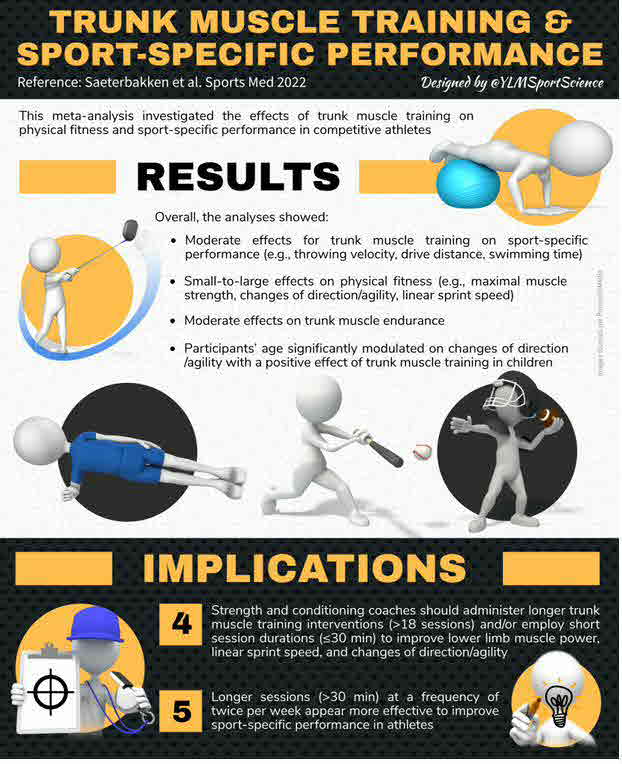
© Copyright 2022 YLMSportScience. Alle Rechte vorbehalten.
Background: The role of trunk muscle training (TMT) for physical ftness (e.g., muscle power) and sport-specifc performance measures (e.g., swimming time) in athletic populations has been extensively examined over the last decades. However, a recent systematic review and meta-analysis on the efects of TMT on measures of physical ftness and sport-specifc perfor mance in young and adult athletes is lacking.
Objective: To aggregate the efects of TMT on measures of physical ftness and sport-specifc performance in young and adult athletes and identify potential subject-related moderator variables (e.g., age, sex, expertise level) and training-related programming parameters (e.g., frequency, study length, session duration, and number of training sessions) for TMT efects.
Data Sources: A systematic literature search was conducted with PubMed, Web of Science, and SPORTDiscus, with no date restrictions, up to June 2021.
Study Eligibility Criteria Only controlled trials with baseline and follow-up measures were included if they examined the efects of TMT on at least one measure of physical ftness (e.g., maximal muscle strength, change-of-direction speed (CODS)/agility, linear sprint speed) and sport-specifc performance (e.g., throwing velocity, swimming time) in young or adult com petitive athletes at a regional, national, or international level. The expertise level was classifed as either elite (competing at national and/or international level) or regional (i.e., recreational and sub-elite).
Study Appraisal and Synthesis Methods: The methodological quality of TMT studies was assessed using the Physiotherapy Evidence Database (PEDro) scale. A random-efects model was used to calculate weighted standardized mean diferences (SMDs) between intervention and active control groups. Additionally, univariate sub-group analyses were independently computed for subject-related moderator variables and training-related programming parameters.
Results: Overall, 31 studies with 693 participants aged 11-37 years were eligible for inclusion. The methodological quality of the included studies was 5 on the PEDro scale. In terms of physical ftness, there were signifcant, small-to-large efects of TMT on maximal muscle strength (SMD =0.39), local muscular endurance (SMD =1.29), lower limb muscle power (SMD=0.30), linear sprint speed (SMD =0.66), and CODS/agility (SMD =0.70). Furthermore, a signifcant and moder ate TMT efect was found for sport-specifc performance (SMD=0.64). Univariate sub-group analyses for subject-related moderator variables revealed signifcant efects of age on CODS/agility (p=0.04), with signifcantly large efects for chil dren (SMD=1.53, p=0.002). Further, there was a signifcant efect of number of training sessions on muscle power and linear sprint speed (p=0.03), with signifcant, small-to-large efects of TMT for>18 sessions compared to=18 sessions (0.45=SMD=0.84, p=0.003). Additionally, session duration signifcantly modulated TMT efects on linear sprint speed, CODS/agility, and sport-specifc performance (p=0.05). TMT with session durations=30 min resulted in signifcant, large efects on linear sprint speed and CODS/agility (1.66=SMD=2.42, p=0.002), whereas session durations>30 min resulted in signifcant, large efects on sport-specifc performance (SMD=1.22, p=0.008).
Conclusions: Our fndings indicate that TMT is an effective means to improve selected measures of physical ftness and sport specifc performance in young and adult athletes. Independent sub-group analyses suggest that TMT has the potential to improve CODS/agility, but only in children. Additionally, more (>18) and/or shorter duration (=30 min) TMT sessions appear to be more efective for improving lower limb muscle power, linear sprint speed, and CODS/agility in young or adult competitive athletes.
© Copyright 2022 Sports Medicine. Springer. Alle Rechte vorbehalten.
| Schlagworte: | |
|---|---|
| Notationen: | Trainingswissenschaft Nachwuchssport |
| Veröffentlicht in: | Sports Medicine |
| Sprache: | Englisch |
| Veröffentlicht: |
2022
|
| Online-Zugang: | https://doi.org/10.1007/s40279-021-01637-0 |
| Jahrgang: | 52 |
| Heft: | 7 |
| Seiten: | 1599-1622 |
| Dokumentenarten: | Artikel |
| Level: | hoch |