

The influence of hamstring muscle peak torque and rate of torque development for sprinting performance in football players: A cross-sectional study
(Der Einfluss des Spitzen-Drehmoments der ischiokruralen Muskulatur und der Geschwindigkeit der Drehmoment-Entwicklung für die Sprint-Leistung bei Fußballspielern: Eine Querschnittsstudie)
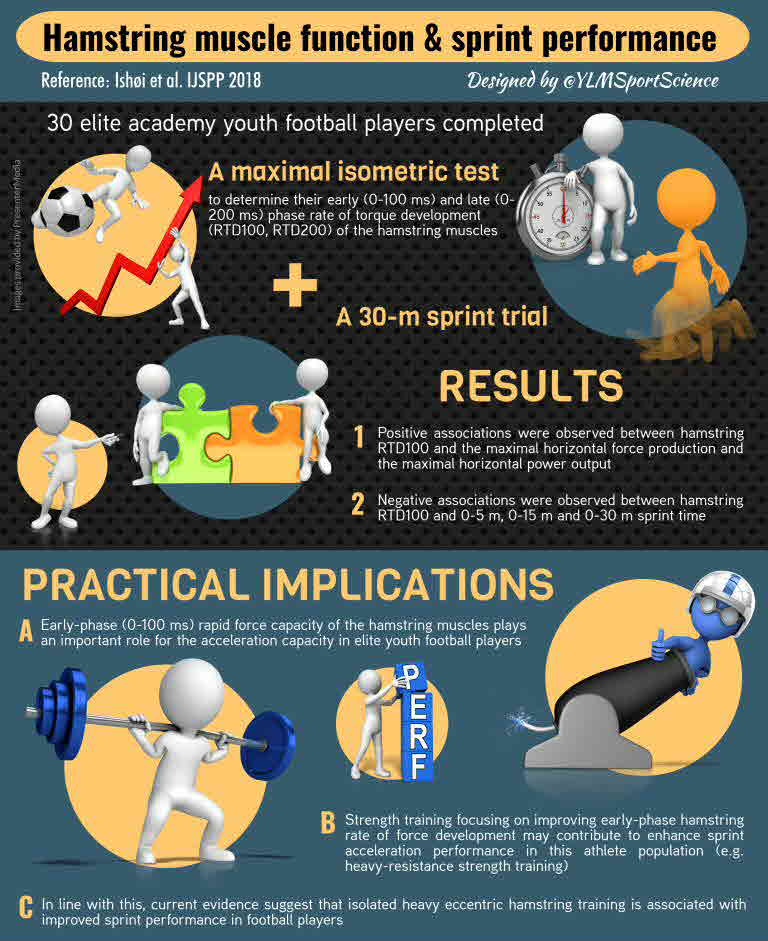
© Copyright 2018 YLMSportScience. Alle Rechte vorbehalten.
Purpose: This cross-sectional study aimed to investigate the association between hamstring muscle peak torque and rapid force capacity (rate of torque development: RTD) versus sprint performance in elite youth football players.
Methods: Thirty elite academy youth football players (16.75 ± 1.1 years, 176.9 ± 6.7 cm, 67.1 ± 6.9 kg) were included. Isometric peak torque (Nm/kg) and early (0-100 ms) and late (0-200 ms) phase RTD (RTD100 , RTD200) (Nm/s/kg) of the hamstring muscles were obtained as independent predictor variables. Sprint performance was assessed during a 30-m sprint trial. Mechanical sprint variables (maximal horizontal force production (FH0) (N/kg); maximal theoretical velocity (V0) (m/s); maximal horizontal power output (Pmax) (W/kg)) and sprint split time s(0-5 m; 0-15 m; 0-30 m; 15-30 m) (s) were derived as dependent variables. Subsequently, linear regression analysis was conducted for each pair of dependent and independent variables.
Results: Positive associations were observed between hamstring RTD100 and FH0 (r2=0.241, p=0.006) and Pmax (r2=0.227, p=0.008) . Furthermore, negative associations were observed between hamstring RTD100 and 0-5 m (r2=0.206, p=0.012), 0-15 m (r2=0.217, p=0.009) and 0-30 m sprint time (r2=0.169, p=0.024) . No other associations were observed.
Conclusion: The present data indicate that early-phase (0-100 ms) rapid force capacity of the hamstring muscles plays an important role for the acceleration capacity in elite youth football players. In contrast , no associations were observed between hamstring muscle function and maximal sprint velocity. This indicates that strength training focusing on improving early-phase hamstring rate of force development may contribute to enhance sprint acceleration performance in this athlete population. Abstract from author
© Copyright 2018 International Journal of Sports Physiology and Performance. Alle Rechte vorbehalten.
| Schlagworte: | |
|---|---|
| Notationen: | Trainingswissenschaft Spielsportarten Nachwuchssport |
| Tagging: | Drehmoment |
| Veröffentlicht in: | International Journal of Sports Physiology and Performance |
| Sprache: | Englisch |
| Veröffentlicht: |
2018
|
| Online-Zugang: | https://journals.humankinetics.com/doi/abs/10.1123/ijspp.2018-0464 |
| Jahrgang: | 14 |
| Heft: | 5 |
| Seiten: | 665-673 |
| Dokumentenarten: | Artikel |
| Level: | hoch |