

Player-tracking technology: Half-full or half-empty glass?
(Spieler-Tracking-Technologie: Das Glas halb voll oder halb leer?)
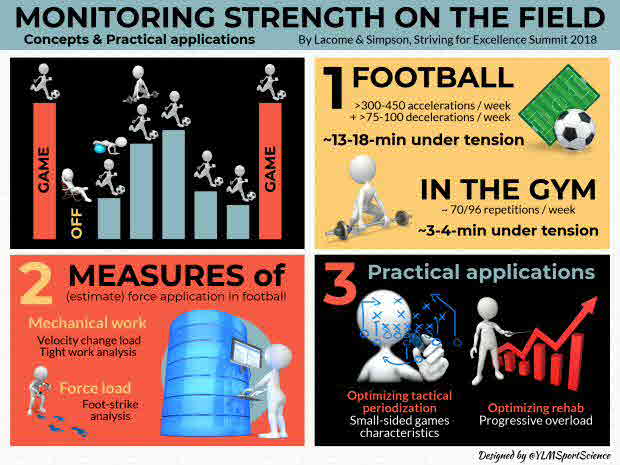
© Copyright 2017 YLMSportScience. Alle Rechte vorbehalten.
With the ongoing development of microtechnology, player tracking has become one of the most important components of load monitoring in team sports. The 3 main objectives of player tracking are better understanding of practice (provide an objective, a posteriori evaluation of external load and locomotor demands of any given session or match), optimization of training-load patterns at the team level, and decision making on individual players` training programs to improve performance and prevent injuries (eg, top-up training vs unloading sequences, return to play progression). This paper discusses the basics of a simple tracking approach and the need to integrate multiple systems. The limitations of some of the most used variables in the field (including metabolic-power measures) are debated, and innovative and potentially new powerful variables are presented. The foundations of a successful player-monitoring system are probably laid on the pitch first, in the way practitioners collect their own tracking data, given the limitations of each variable, and how they report and use all this information, rather than in the technology and the variables per se. Overall, the decision to use any tracking technology or new variable should always be considered with a cost/benefit approach (ie, cost, ease of use, portability, manpower/ability to affect the training program). Abstract from author
© Copyright 2017 International Journal of Sports Physiology and Performance. Alle Rechte vorbehalten.
| Schlagworte: | |
|---|---|
| Notationen: | Naturwissenschaften und Technik Spielsportarten |
| Veröffentlicht in: | International Journal of Sports Physiology and Performance |
| Sprache: | Englisch |
| Veröffentlicht: |
2017
|
| Online-Zugang: | https://journals.humankinetics.com/doi/abs/10.1123/ijspp.2016-0499 |
| Jahrgang: | 12 |
| Heft: | S2 |
| Seiten: | 35-41 |
| Dokumentenarten: | Artikel |
| Level: | hoch |