
New records in human power
© Copyright 2018 YLMSportScience. All rights reserved.
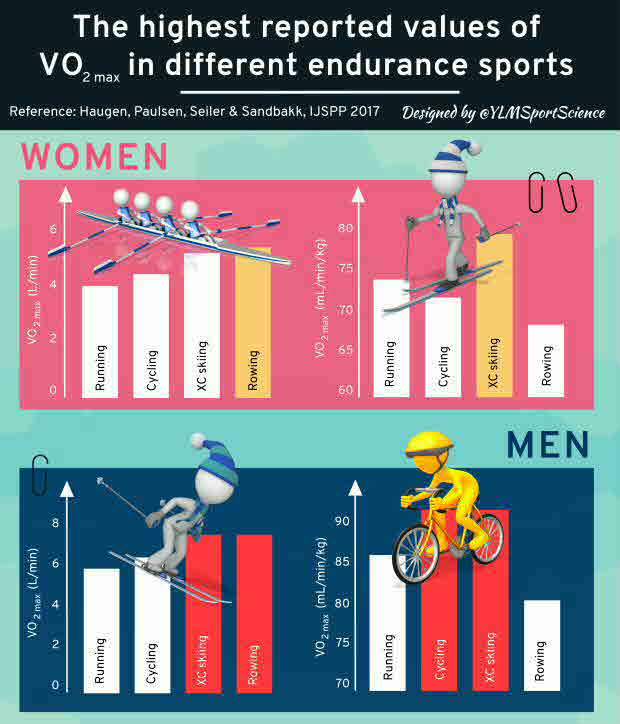
Maximal aerobic and anaerobic power are crucial performance determinants in most sport disciplines. Numerous studies have published power data from elite athletes over the years, particularly in runners, cyclists, rowers, and cross-country (XC) skiers. This invited review defines the current "world records" in human upper limits of aerobic and anaerobic power. Currently, V.O2 max values of ~7.5 and 7.0 L/min in male XC skiers and rowers, respectively, and/or ~90 mL/kg·min in XC skiers, cyclists, and runners can be described as upper human limits for aerobic power. Corresponding values for women are slightly below 5.0 L/min in rowers and XC skiers and ~80 mL/kg·min in XC skiers and runners. Extremely powerful male athletes may reach ~85 W/kg in countermovement jump (peak vertical power) and ~36 W/kg in sprint running (peak horizontal power), cycling (instantaneous power during force-velocity testing from a standing position), and rowing (instantaneous power). Similarly, their female counterparts may reach ~70 W/kg in countermovement jump and ~30 W/kg in sprint running, cycling, and rowing. The presented values can serve as reference values for practitioners and scientists working with elite athletes. However, several methodological considerations should be taken into account when interpreting the results. For example, calibrated apparatus and strict procedures are required to ensure high measurement validity and reliability, and the sampling rate for anaerobic power assessments must be strictly predetermined and carefully measured. Doping is also a potential confounding factor when interpreting the human upper limits of aerobic and anaerobic power.
© Copyright 2018 International Journal of Sports Physiology and Performance. All rights reserved.
| Subjects: | |
|---|---|
| Notations: | training science endurance sports |
| Published in: | International Journal of Sports Physiology and Performance |
| Language: | English |
| Published: |
2018
|
| Online Access: | https://doi.org/10.1123/ijspp.2017-0441 |
| Volume: | 13 |
| Issue: | 6 |
| Pages: | 678-686 |
| Document types: | article |
| Level: | advanced |