

The training characteristics of worl-class distance runners: An integration of scientific literature and results-proven practice
(Die Trainingsmerkmale von Weltklasse-Langstreckenläufern: Eine Integration von wissenschaftlicher Literatur und ergebnisorientierter Praxis)
© Copyright 2022 YLMSportScience. Alle Rechte vorbehalten.
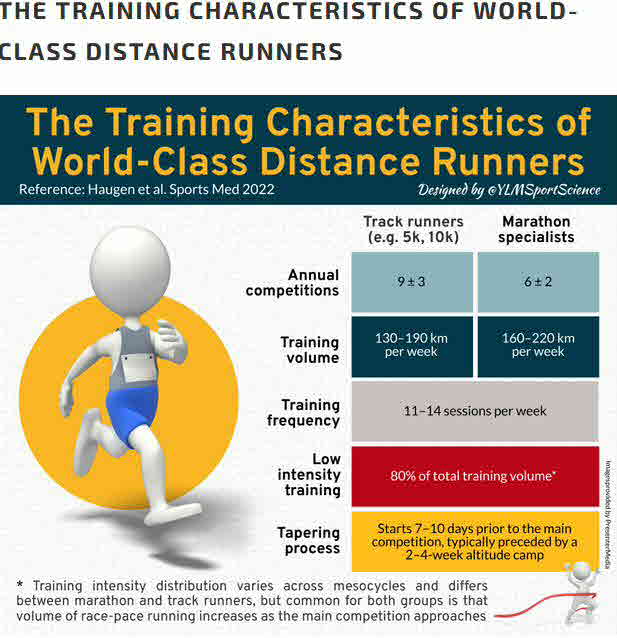
In this review we integrate the scientific literature and results-proven practice and outline a novel framework for understanding the training and development of elite long-distance performance. Herein, we describe how fundamental training characteristics and well-known training principles are applied. World-leading track runners (i.e., 5000 and 10,000m) and marathon specialists participate in 9 ± 3 and 6 ± 2 (mean ± SD) annual competitions, respectively. The weekly running distance in the mid-preparation period is in the range 160-220km for marathoners and 130-190km for track runners. These differences are mainly explained by more running kilometers on each session for marathon runners. Both groups perform 11-14 sessions per week, and = 80% of the total running volume is performed at low intensity throughout the training year. The training intensity distribution vary across mesocycles and differ between marathon and track runners, but common for both groups is that volume of race-pace running increases as the main competition approaches. The tapering process starts 7-10days prior to the main competition. While the African runners live and train at high altitude (2000-2500m above sea level) most of the year, most lowland athletes apply relatively long altitude camps during the preparation period. Overall, this review offers unique insights into the training characteristics of world-class distance runners by integrating scientific literature and results-proven practice, providing a point of departure for future studies related to the training and development in the Olympic long-distance events.
Key Points
This review bridges the gap between science and results-proven practice regarding how training principles and training methods should be applied for the Olympic long-distance events and identified clear distinctions in training organization between track runners and marathon specialists
The weekly running distance is in the range 160-220km for marathoners and 130-190km for track runners, with both groups performing 11-14 sessions per week, and = 80% of the total running volume at low intensity
Training intensity distribution varies across mesocycles and differs between marathon and track runners, but common for both groups is that volume of race-pace running increases as the main competition approaches
© Copyright 2022 Sports Medicine - Open. Springer Open. Alle Rechte vorbehalten.
| Schlagworte: | |
|---|---|
| Notationen: | Ausdauersportarten |
| Veröffentlicht in: | Sports Medicine - Open |
| Sprache: | Englisch |
| Veröffentlicht: |
2022
|
| Online-Zugang: | https://sportsmedicine-open.springeropen.com/articles/10.1186/s40798-022-00438-7 |
| Jahrgang: | 8 |
| Seiten: | 46 |
| Dokumentenarten: | Artikel |
| Level: | hoch |