

Sleep or swim? Early-morning training severely restricts the amount of sleep obtained by elite swimmers
(Schlafen oder schwimmen? Das Training am frühen Morgen schränkt die Schlafqualität von Eliteschwimmern stark ein)
© Copyright 2014 YLMSportScience. Alle Rechte vorbehalten.
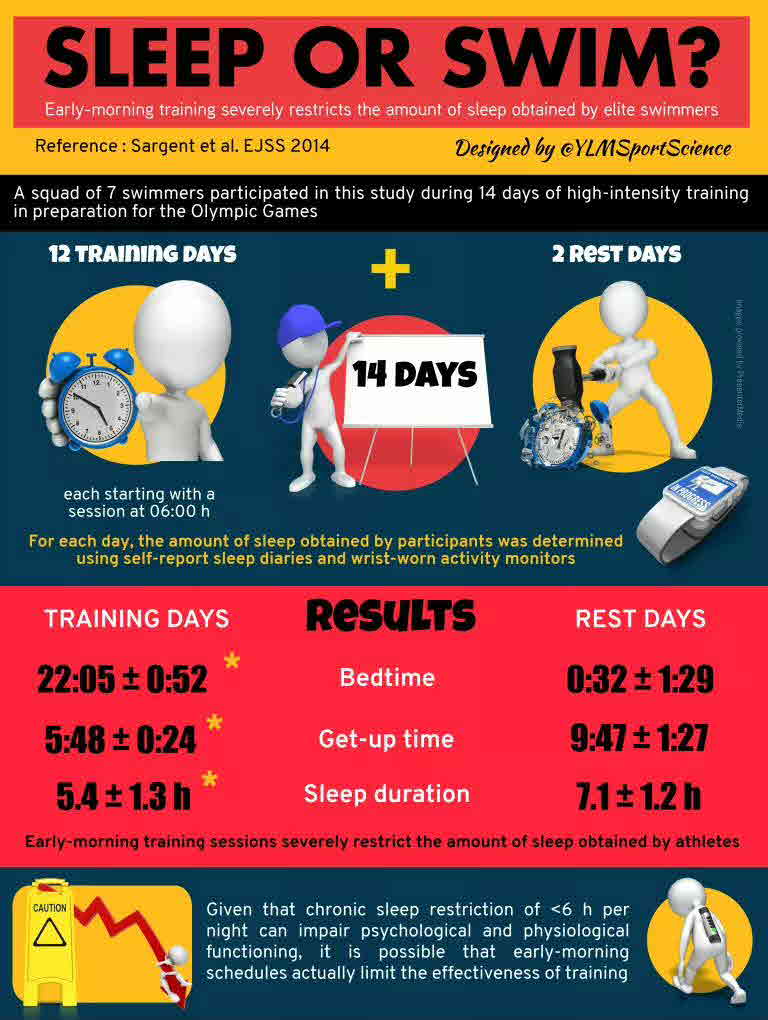
Good sleep is essential for optimal performance, yet few studies have examined the sleep/wake behaviour of elite athletes. Theaim of this study was to assess the impact of early-morning training on the amount of sleep obtained by world-class swimmers.A squad of seven swimmers from the Australian Institute of Sport participated in this study during 14 days of high-intensitytraining in preparation for the 2008 Olympic Games. During these 14 days, participants had 12 training days, each startingwith a session at 06:00 h, and 2 rest days. For each day, the amount of sleep obtained by participants was determined usingself-report sleep diaries and wrist-worn activity monitors. On nights that preceded training days, participants went to bed at22:05 h (s = 00:52), arose at 05:48 h (s = 00:24) and obtained 5.4 h (s = 1.3) of sleep. On nights that preceded rest days,participants went to bed at 00:32 h (s = 01:29), arose at 09:47 h (s = 01:47) and obtained 7.1 h (s = 1.2) of sleep. Mixed model analyses revealed that on nights prior to training days, bedtimes and get-up times were significantly earlier (p< 0.001), timespent in bed was significantly shorter (p < 0.001) and the amount of sleep obtained was significantly less (p < 0.001), than onnights prior to rest days. These results indicate that early-morning training sessions severely restrict the amount of sleepobtained by elite athletes. Given that chronic sleep restriction of < 6 h per night can impair psychological and physiologicalfunctioning, it is possible that early-morning schedules actually limit the effectiveness of training
© Copyright 2014 European Journal of Sport Science. Wiley. Alle Rechte vorbehalten.
| Schlagworte: | |
|---|---|
| Notationen: | Ausdauersportarten Biowissenschaften und Sportmedizin Trainingswissenschaft |
| Veröffentlicht in: | European Journal of Sport Science |
| Sprache: | Englisch |
| Veröffentlicht: |
2014
|
| Online-Zugang: | https://www.tandfonline.com/doi/full/10.1080/17461391.2012.696711 |
| Jahrgang: | 14 |
| Heft: | S1 |
| Seiten: | S310-S315 |
| Dokumentenarten: | Artikel |
| Level: | hoch |