

Details our eyes cannot see: Challenges for the analysis of body position during bicycle fitting
(Details, die unsere Augen nicht sehen: Herausforderungen für die Analyse der Körperhaltung bei der Fahrradanpassung)
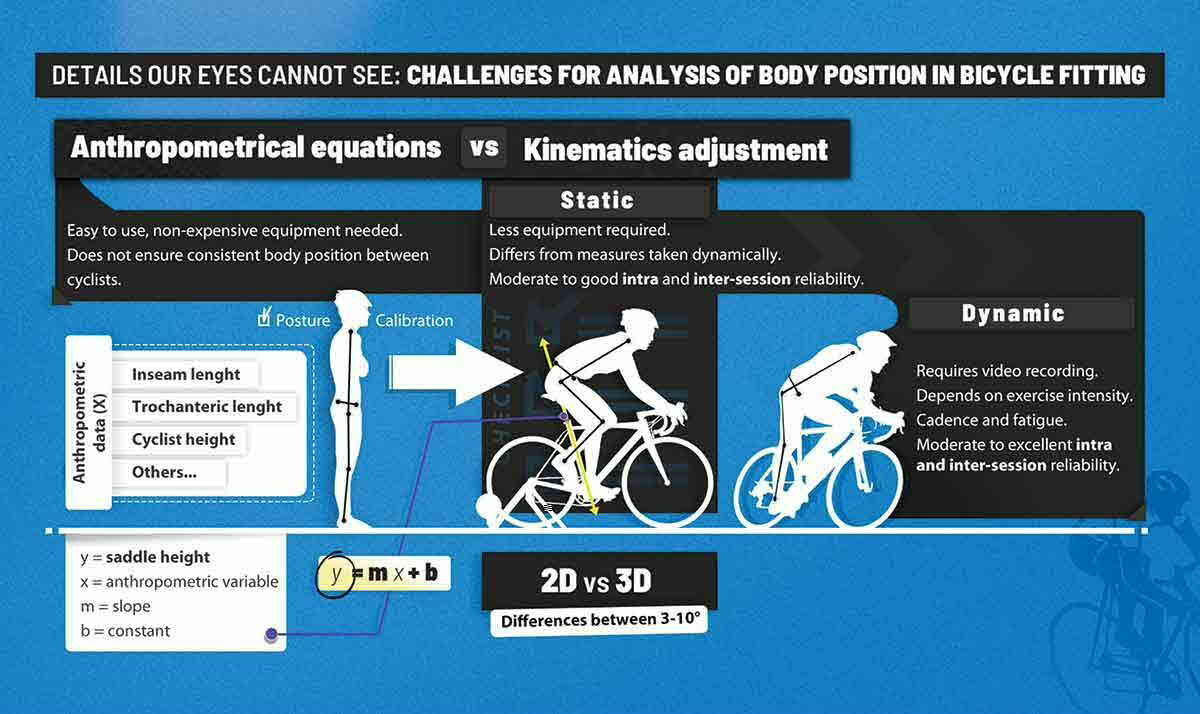
Bicycle fitting is popular and largely beneficial to a range of cyclists, but consistency in methods to assess posture of cyclists on their bicycles is lacking. This is critical because decisions on if and how to change bicycle fitting are largely dependent on the validity and reliability of assessment outcomes. Therefore, we propose that
1. Whenever bicycle fitters are limited in terms of technology, static methods can be used to provide initial data (Swart & Holliday, 2019), taking into account cyclists with inter-limb asymmetry in length (i.e., both limbs should be assessed).
2. If video-recording resources are accessible (i.e., two-dimensional), bicycle fitting should involve movement analysis and measurements of angles, in line with existing data (Bini & Hume, 2016; Millour et al., 2019a; Swart & Holliday, 2019).
3. Posture of cyclists out of the bicycle should be considered in the fitting with the purpose of individualising the analysis of the body position on the bicycle (Holliday & Swart, 2021).
4. For dynamic analysis, cyclists should exercise at intensity and cadence similar to their training profile (Bini et al., 2012; Holliday et al., 2019; Peveler et al., 2012).
5. Whenever available, three-dimensional motion analysis is preferred in order to increase validity of data obtained from different planes of motion (Fonda et al., 2014; Holliday et al., 2017; Umberger & Martin, 2001).
6. The implementation of novel technology (i.e., IMUs and marker-less) for bike fit requires caution particularly when small changes in the body position are sought.
7. Future research should inform a consensus on key elements for assessment of the body position on the bicycle and bicycle fitting, including data on joint moments and power for a range of populations (e.g., injured and those with chronic illness).
© Copyright 2023 Sports Biomechanics. Routledge. Veröffentlicht von Routledge. Alle Rechte vorbehalten.
| Schlagworte: | |
|---|---|
| Notationen: | Naturwissenschaften und Technik Ausdauersportarten |
| Veröffentlicht in: | Sports Biomechanics |
| Sprache: | Englisch |
| Veröffentlicht: |
Routledge
2023
|
| Online-Zugang: | https://doi.org/10.1080/14763141.2021.1987509 |
| Jahrgang: | 22 |
| Heft: | 4 |
| Seiten: | 485-493 |
| Dokumentenarten: | Artikel |
| Level: | hoch |