
The effects of Red Bull Energy Drink compared with caffeine on cycling time-trial performance
(Die Auswirkungen des Red Bull Energy Drinks im Vergleich zu Koffein auf die Zeitfahrleistung im Radsport)
© Copyright 2015 YLMSportScience. Alle Rechte vorbehalten.
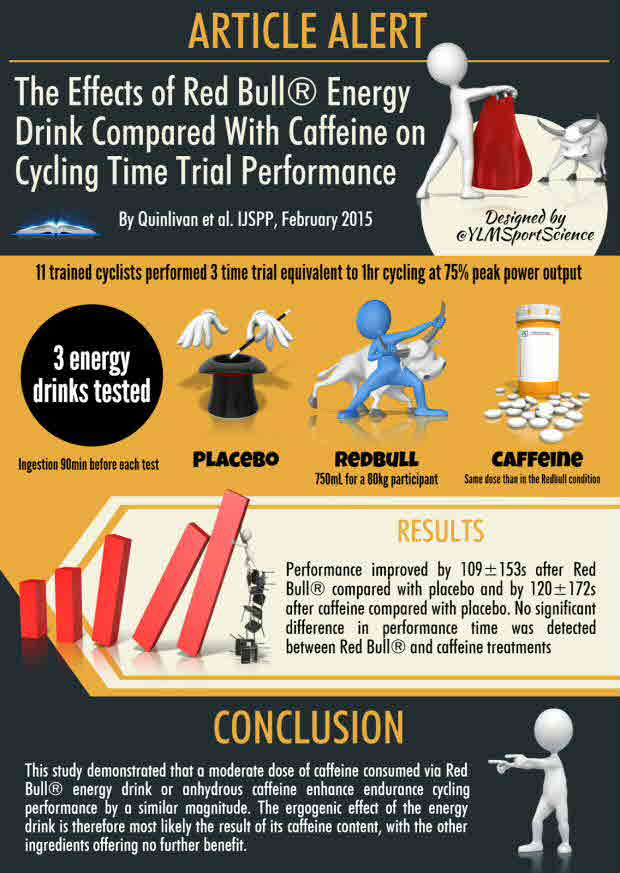
This study investigated the ergogenic effects of a commercial energy drink (Red Bull) or an equivalent dose of anhydrous caffeine in comparison with a noncaffeinated control beverage on cycling performance. Eleven trained male cyclists (31.7 ± 5.9 y 82.3 ± 6.1 kg, VO2max = 60.3 ± 7.8 mL/kg·min) participated in a double-blind, placebo-controlled, crossover-design study involving 3 experimental conditions. Participants were randomly administered Red Bull (9.4 mL/kg body mass [BM] containing 3 mg/kg BM caffeine), anhydrous caffeine (3 mg/kg BM given in capsule form), or a placebo 90 min before commencing a time trial equivalent to 1 h cycling at 75% peak power output. Carbohydrate and fluid volumes were matched across all trials. Performance improved by 109 ± 153 s (2.8%, P = .039) after Red Bull compared with placebo and by 120 ± 172 s (3.1%, P = .043) after caffeine compared with placebo. No significant difference (P > .05) in performance time was detected between Red Bull and caffeine treatments. There was no significant difference (P > .05) in mean heart rate or rating of perceived exertion among the 3 treatments. This study demonstrated that a moderate dose of caffeine consumed as either Red Bull or in anhydrous form enhanced cycling time-trial performance. The ergogenic benefits of Red Bull energy drink are therefore most likely due to the effects of caffeine, with the other ingredients not likely to offer additional benefit.
© Copyright 2015 International Journal of Sports Physiology and Performance. Alle Rechte vorbehalten.
| Schlagworte: | |
|---|---|
| Notationen: | Ausdauersportarten Biowissenschaften und Sportmedizin |
| Tagging: | Koffein |
| Veröffentlicht in: | International Journal of Sports Physiology and Performance |
| Sprache: | Englisch |
| Veröffentlicht: |
2015
|
| Online-Zugang: | http://doi.org/10.1123/ijspp.2014-0481 |
| Jahrgang: | 10 |
| Heft: | 7 |
| Seiten: | 897-901 |
| Dokumentenarten: | Artikel |
| Level: | hoch |