

Effects of resistance training on neuromuscular characteristics and pacing during 10-km running time trial
(Auswirkungen von Widerstanstraining auf neuromuskuläre Merkmale und Renntempogestaltung in einem 10-km-Lauf)
© Copyright 2015 YLMSportScience. Alle Rechte vorbehalten.
Purpose
The purpose of this study was to analyze the impact of an 8-week strength training program on the neuromuscular characteristics and pacing adopted by runners during a self-paced endurance running.
Methods
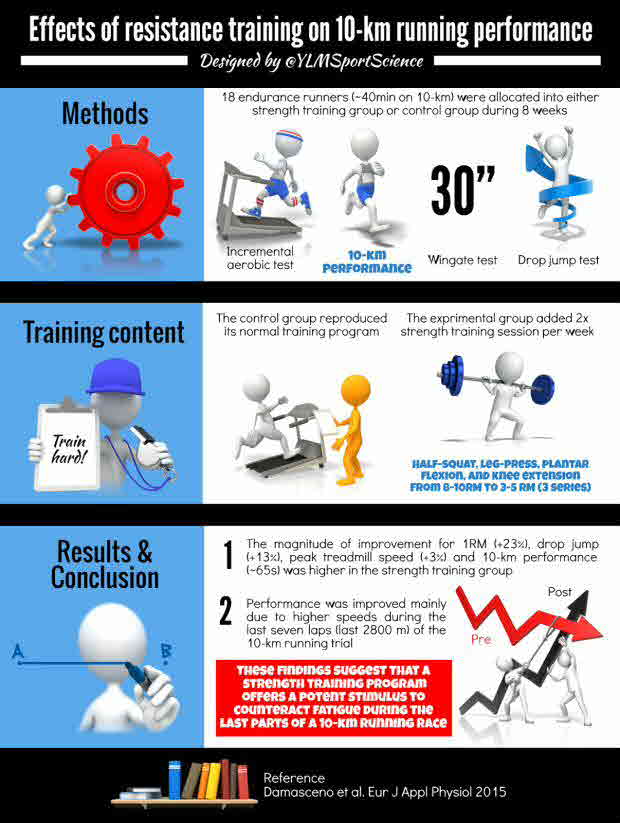
Eighteen endurance runners were allocated into either strength training group (STG, n = 9) or control group (CG, n = 9) and performed the following tests before and after the training period: (a) incremental test, (b) running speed-constant test, (c) 10-km running time trial, (d) drop jump test, (e) 30-s Wingate anaerobic test, (f) maximum dynamic strength test (1RM). During 1RM, the electromyographic activity was measured.
Results
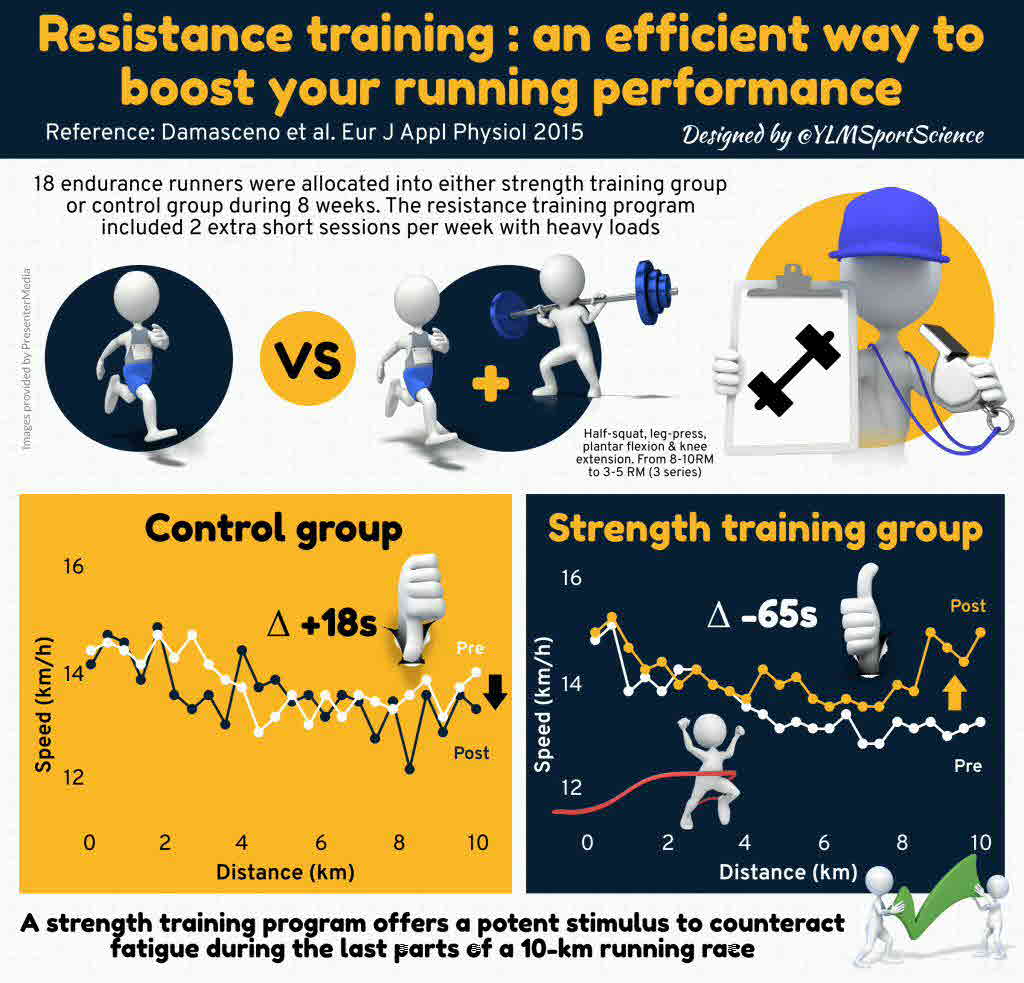
In the STG, the magnitude of improvement for 1RM (23.0 ± 4.2 %, P = 0.001), drop jump (12.7 ± 4.6 %, P = 0.039), and peak treadmill speed (2.9 ± 0.8 %, P = 0.013) was significantly higher compared to CG. This increase in the 1RM for STG was accompanied by a tendency to a higher electromyographic activity (P = 0.080). The magnitude of improvement for 10-km running performance was higher (2.5 %) for STG than for CG (-0.7 %, P = 0.039). Performance was improved mainly due to higher speeds during the last seven laps (last 2800 m) of the 10-km running trial. There were no significant differences between before and after training period for maximal oxygen uptake, respiratory compensation point, running economy, and anaerobic performance for both groups (P > 0.05).
Conclusions
These findings suggest that a strength training program offers a potent stimulus to counteract fatigue during the last parts of a 10-km running race, resulting in an improved overall running performance.
© Copyright 2015 European Journal of Applied Physiology. Springer. Alle Rechte vorbehalten.
| Schlagworte: | |
|---|---|
| Notationen: | Ausdauersportarten |
| Tagging: | Pacing |
| Veröffentlicht in: | European Journal of Applied Physiology |
| Sprache: | Englisch |
| Veröffentlicht: |
2015
|
| Online-Zugang: | http://doi.org/10.1007/s00421-015-3130-z |
| Jahrgang: | 15 |
| Heft: | 7 |
| Seiten: | 1513-1522 |
| Dokumentenarten: | Artikel |
| Level: | hoch |