

Accuracy of indirect estimation of power output from uphill performance in cycling
(Genauigkeit der indirekten Bestimmung der Leistungsabgabe aus der Berganfahrleistung im Radsport)
© Copyright 2014 YLMSportScience. Alle Rechte vorbehalten.
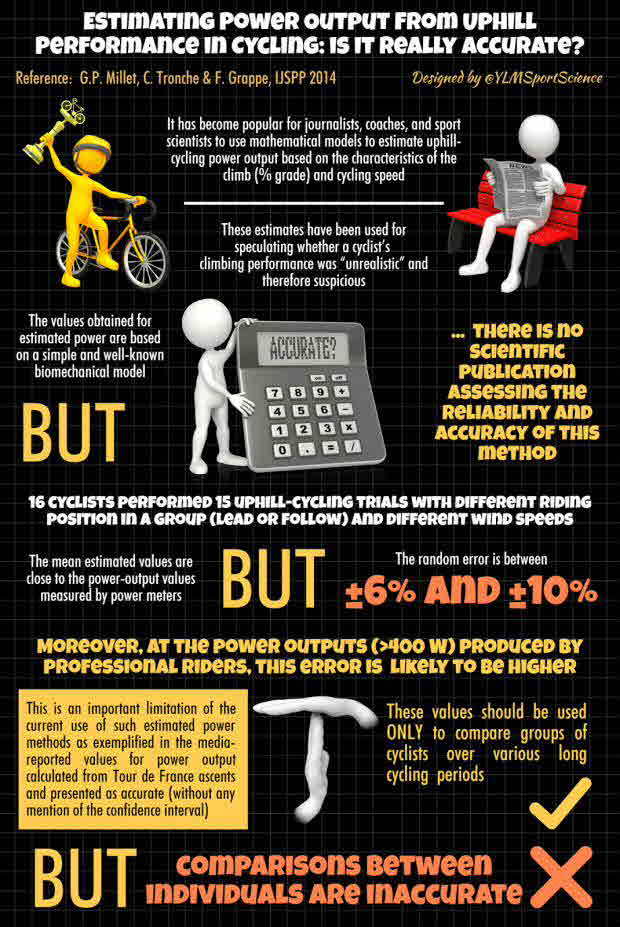
Purpose: To use measurement by cycling power meters (Pmes) to evaluate the accuracy of commonly used models for estimating uphill cycling power (Pest). Experiments were designed to explore the influence of wind speed and steepness of climb on accuracy of Pest. The authors hypothesized that the random error in Pest would be largely influenced by the windy conditions, the bias would be diminished in steeper climbs, and windy conditions would induce larger bias in Pest. Methods: Sixteen well-trained cyclists performed 15 uphill-cycling trials (range: length 1.3-6.3 km, slope 4.4-10.7%) in a random order. Trials included different riding position in a group (lead or follow) and different wind speeds. Pmes was quantified using a power meter, and Pest was calculated with a methodology used by journalists reporting on the Tour de France. Results: Overall, the difference between Pmes and Pest was -0.95% (95%CI: -10.4%, +8.5%) for all trials and 0.24% (-6.1%, +6.6%) in conditions without wind (<2 m/s). The relationship between percent slope and the error between Pest and Pmes were considered trivial. Conclusions: Aerodynamic drag (affected by wind velocity and orientation, frontal area, drafting, and speed) is the most confounding factor. The mean estimated values are close to the power-output values measured by power meters, but the random error is between ±6% and ±10%. Moreover, at the power outputs (>400 W) produced by professional riders, this error is likely to be higher. This observation calls into question the validity of releasing individual values without reporting the range of random errors.
© Copyright 2014 International Journal of Sports Physiology and Performance. Alle Rechte vorbehalten.
| Schlagworte: | |
|---|---|
| Notationen: | Ausdauersportarten |
| Veröffentlicht in: | International Journal of Sports Physiology and Performance |
| Sprache: | Englisch |
| Veröffentlicht: |
2014
|
| Online-Zugang: | http://doi.org/10.1123/IJSPP.2013-0320 |
| Jahrgang: | 9 |
| Heft: | 5 |
| Seiten: | 778-783 |
| Dokumentenarten: | Artikel |
| Level: | hoch |