

Influence of physical qualities on post-match fatigue in rugby league players
(Einfluss der physischen Eigenschaften auf die Ermüdung nach dem Spiel bei Spielern der Rugby League )
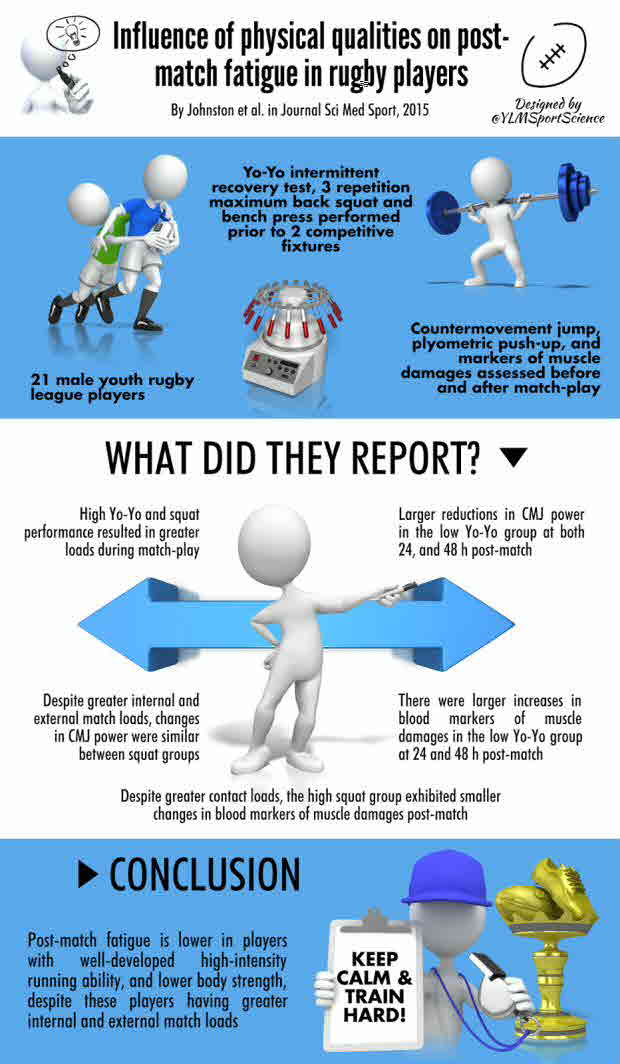
© Copyright 2015 YLMSportScience. Alle Rechte vorbehalten.
Objectives: This study examined the influence of physical qualities on markers of fatigue and muscle damage following rugby league match-play.
Design: Between subjects design.
Methods: Twenty-one male youth rugby league players (age 19.2 ± 0.7 years; height 180.7 ± 5.6 cm; body mass 89.9 ± 10.0 kg) participated in the study. Yo-Yo intermittent recovery test (level 1), 3 repetition maximum back squat and bench press were assessed prior to 2 competitive fixtures. Neuromuscular fatigue (countermovement jump [CMJ] and plyometric push-up [PP]), and blood creatine kinase (CK) were assessed before and after match-play. During match-play, movements were recorded using microtechnology. Players were divided into high- and low-groups based on physical qualities.
Results: High Yo-Yo and squat performance resulted in greater loads during match-play (p < 0.05). There were larger reductions in CMJ power in the low Yo-Yo group at both 24 (ES = -1.83), and 48 h post-match (ES = -1.33). Despite greater internal and external match loads, changes in CMJ power were similar between squat groups. There were larger increases in blood CK in the low Yo-Yo group at 24 (73% vs. 176%; ES = 1.50) and 48 h post-match (28% vs. 80%; ES = 1.22). Despite greater contact loads, the high squat group exhibited smaller changes in blood CK post-match (ES = 0.25-0.39).
Conclusions: Post-match fatigue is lower in players with well-developed high-intensity running ability, and lower body strength, despite these players having greater internal and external match loads.
© Copyright 2015 Journal of Science and Medicine in Sport. Elsevier. Alle Rechte vorbehalten.
| Schlagworte: | |
|---|---|
| Notationen: | Spielsportarten |
| Veröffentlicht in: | Journal of Science and Medicine in Sport |
| Sprache: | Englisch |
| Veröffentlicht: |
2015
|
| Online-Zugang: | http://doi.org/10.1016/j.jsams.2014.01.009 |
| Jahrgang: | 18 |
| Heft: | 2 |
| Seiten: | 209-213 |
| Dokumentenarten: | Artikel |
| Level: | hoch |