

Comparing sleep in shared and individual rooms during training camps in elite youth soccer players: a short report
(Vergleich des Schlafs in Mehrbettzimmern und Einzelzimmern während Trainingslagern bei Elite-Jugendfußballern: ein Kurzbericht)
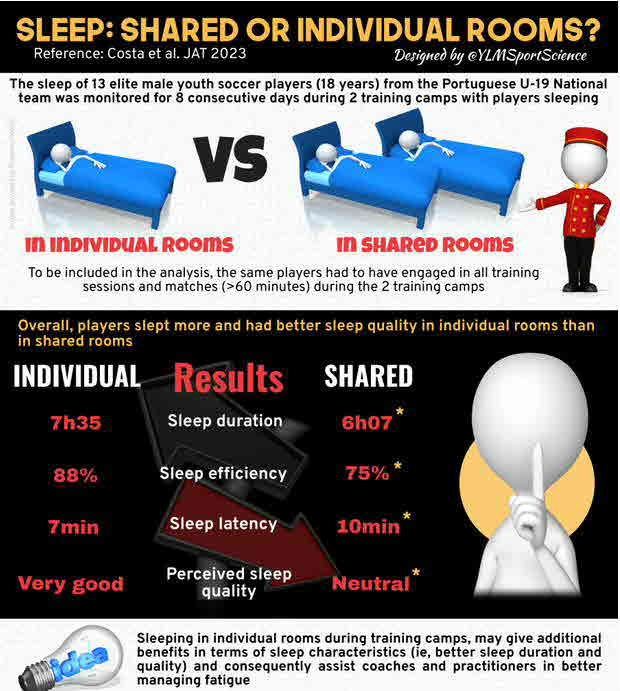
© Copyright 2023 YLMSportScience. Alle Rechte vorbehalten.
Context
Athletes' sleep is the most important recovery strategy and has received growing attention. However, athletes may experience sleep disruptions due to numerous factors, such as training and competition workloads, travel, changes in sleep-wake schedules, and sleeping environments. They often spend nights in unfamiliar hotels, and sharing a bed, room, or both with another person might affect sleep duration and quality.
Objective
To analyze the effect of sleeping in shared (SRs) versus individual (IRs) rooms on objective and subjective sleep and on slow-wave-sleep-derived cardiac autonomic activity during an official training camp in elite youth soccer players. Training and match workloads were characterized.
Design
Observational case study.
Setting
Hotel accommodations.
Patients or Other Participants
Thirteen elite male youth soccer players.
Results
Players slept longer in IRs than in SRs (+1:28 [95% CI = 1:18, 1:42] hours:minutes; P < .001). Sleep efficiency was higher in IRs than in SRs (+12% [95% CI = 10%, 15%]; P < .001), whereas sleep latency was shorter in IRs than in SRs (-3 [95% CI = -15, -4] minutes; P < .001). Subjective sleep quality was lower in IRs than in SRs (-2 [-3 to -2] arbitrary units; P < .001). No differences were found for slow-wave-sleep-derived cardiac autonomic activity or for training or match workloads between training camps.
Conclusions
During soccer training camps, sleep may be affected by whether the athlete is in an SR versus an IR.
© Copyright 2023 Journal of Athletic Training. National Athletic Trainers' Association. Alle Rechte vorbehalten.
| Schlagworte: | |
|---|---|
| Notationen: | Spielsportarten Nachwuchssport Biowissenschaften und Sportmedizin |
| Veröffentlicht in: | Journal of Athletic Training |
| Sprache: | Englisch |
| Veröffentlicht: |
2023
|
| Online-Zugang: | https://doi.org/10.4085/1062-6050-0042.22 |
| Jahrgang: | 58 |
| Heft: | 1 |
| Seiten: | 79-83 |
| Dokumentenarten: | Artikel |
| Level: | hoch |