

Elite football teams that do not have a winter break lose on average 303 player-days more per season to injuries than those teams that do: a comparison among 35 professional European teams
(Elite-Fußballteams, die keine Winterpause einlegen, verlieren im Durchschnitt 303 Spielertage mehr pro Saison durch Verletzungen als die Teams, die dies tun: ein Vergleich unter 35 europäischen Profiteams)
© Copyright 2019 YLMSportScience. Alle Rechte vorbehalten.
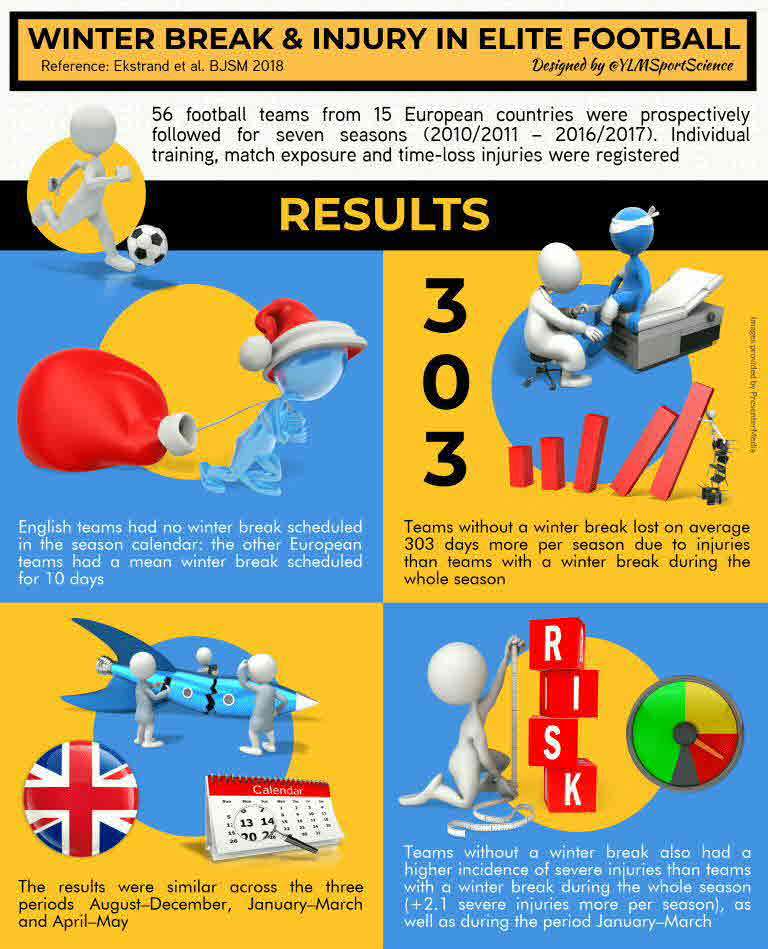
Objective: To compare injury rates among professional men`s football teams that have a winter break in their league season schedule with corresponding rates in teams that do not.Methods 56 football teams from 15 European countries were prospectively followed for seven seasons (2010/2011-2016/2017)—a total of 155 team-seasons. Individual training, match exposure and time-loss injuries were registered. Four different injury rates were analysed over four periods within the season, and linear regression was performed on team-level data to analyse the effect of winter break on each of the injury rates. Crude analyses and analyses adjusted for climatic region were performed.
Results: 9660 injuries were reported during 1 447 011 exposure hours. English teams had no winter break scheduled in the season calendar: the other European teams had a mean winter break scheduled for 10.0 days. Teams without a winter break lost on average 303 days more per season due to injuries than teams with a winter break during the whole season (p<0.001). The results were similar across the three periods August-December (p=0.013), January-March (p<0.001) and April-May (p=0.050). Teams without a winter break also had a higher incidence of severe injuries than teams with a winter break during the whole season (2.1 severe injuries more per season for teams without a winter break, p=0.002), as well as during the period January-March (p=0.003). A winter break was not associated with higher team training attendance or team match availability. Climatic region was also associated with injury rates.
Conclusions: The absence of a scheduled winter break was associated with a higher injury burden, both before and during the two periods following the time that many European teams take a winter break. Teams without a winter break (English clubs) had a higher incidence of severe injuries following the time of the year that other teams (other European clubs) had their scheduled break.
© Copyright 2019 British Journal of Sports Medicine. BMJ Publishing Group Ltd of the BMA. Alle Rechte vorbehalten.
| Schlagworte: | |
|---|---|
| Notationen: | Biowissenschaften und Sportmedizin |
| Veröffentlicht in: | British Journal of Sports Medicine |
| Sprache: | Englisch |
| Veröffentlicht: |
2019
|
| Online-Zugang: | http://bjsm.bmj.com/content/53/19/1231.abstract |
| Jahrgang: | 53 |
| Heft: | 19 |
| Seiten: | 1231-1235 |
| Dokumentenarten: | Artikel |
| Level: | hoch |