

The effect of concurrent training organisation in youth elite soccer players
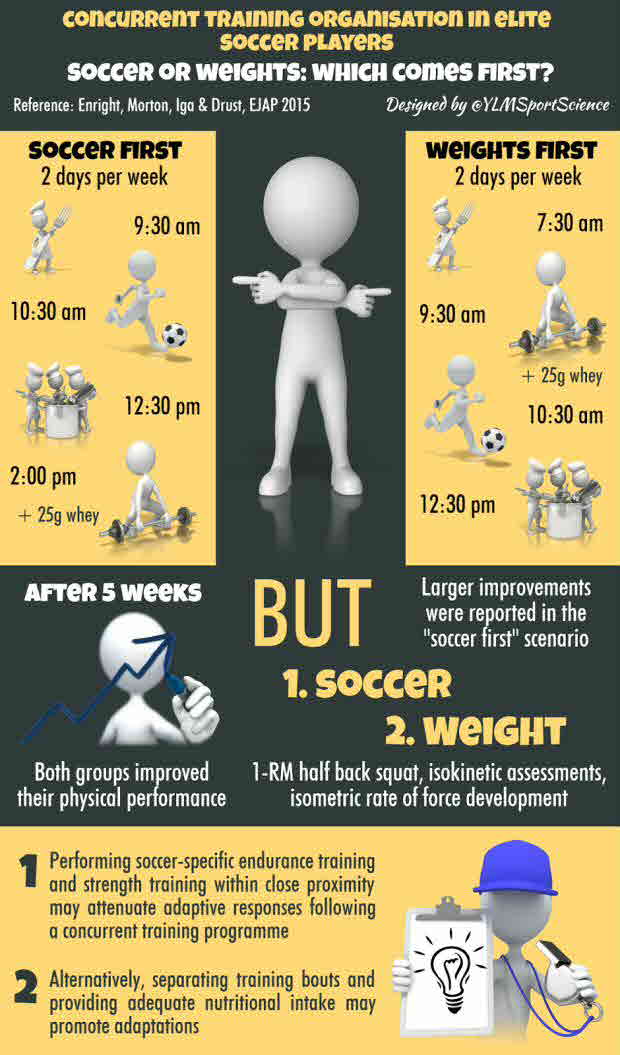
© Copyright 2015 YLMSportScience. All rights reserved.
Purpose
This study compared the adaptive responses to two concurrent training programmes frequently used in professional soccer.
Methods
Fifteen youth soccer players (17.3 ± 1.6 years, 1.82 ± 0.06 m, 77.0 ± 7.3 kg; VO2 peak, 62.0 ± 4.7 ml-1 kg-1 min-1) who compete in the English Premier League volunteered for this study. In addition to completing their habitual training practices, the participants were asked to alter the organisation concurrent training by performing strength (S) training either prior to (S + E, n = 8) or after (E + S, n = 7) soccer-specific endurance training (E) 2d wk-1 for 5 wk-1.
Results
With the exception of 30 m sprint, IMVC PF, quadriceps strength (60°/sCON, 180°/sCON, 120°/sECC) pooled data revealed training effects across all other performances measures (P < 0.05). Whilst ANCOVA indicated no significant interaction effects for training condition, the difference between the means divided by the pooled standard deviation demonstrated large effect sizes in the E + S condition for in HBS 1-RM [S + E vs E + S; -0.54 (9.6 %) vs -1.79 (19.6 %)], AoP-M [-0.72 (7.9 %) vs -1.76 (14.4 %)], SJ [-0.56, (4.4 %), vs -1.08, (8.1 %)], IMVC-LR; [-0.50, (20.3 %) vs -1.05 (27.3 %)], isokinetic hamstring strength 60°/s CON [-0.64, (12.2 %) vs -0.95 (19.2 %)], 120°/sECC [-0.78 (27.9 %) vs -1.55 (23.3 %)] and isokinetic quadriceps strength 180°/s CON [-0.23 (2.5 %) vs -1.52 (13.2 %)].
Conclusion
Results suggest the organisation of concurrent training, recovery time allocated between training bouts and the availability nutrition may be able to modulate small but clinically significant changes in physical performance parameters associated with match-play. This may have practical implications for practitioners who prescribe same day concurrent training protocols.
© Copyright 2015 European Journal of Applied Physiology. Springer. All rights reserved.
| Subjects: | |
|---|---|
| Notations: | management and organisation of sport junior sports |
| Published in: | European Journal of Applied Physiology |
| Language: | English |
| Published: |
2015
|
| Online Access: | https://link.springer.com/article/10.1007/s00421-015-3218-5 |
| Volume: | 115 |
| Issue: | 11 |
| Pages: | 2367-2381 |
| Document types: | info graphics |
| Level: | advanced |