

Qualitative perspectives on how Manchester United Football Club developed and sustained serial winning
(Eine qualitative Betrachtung darüber wie der FC Manchester United eine langanhaltende Siegserie entwickeln konnte)
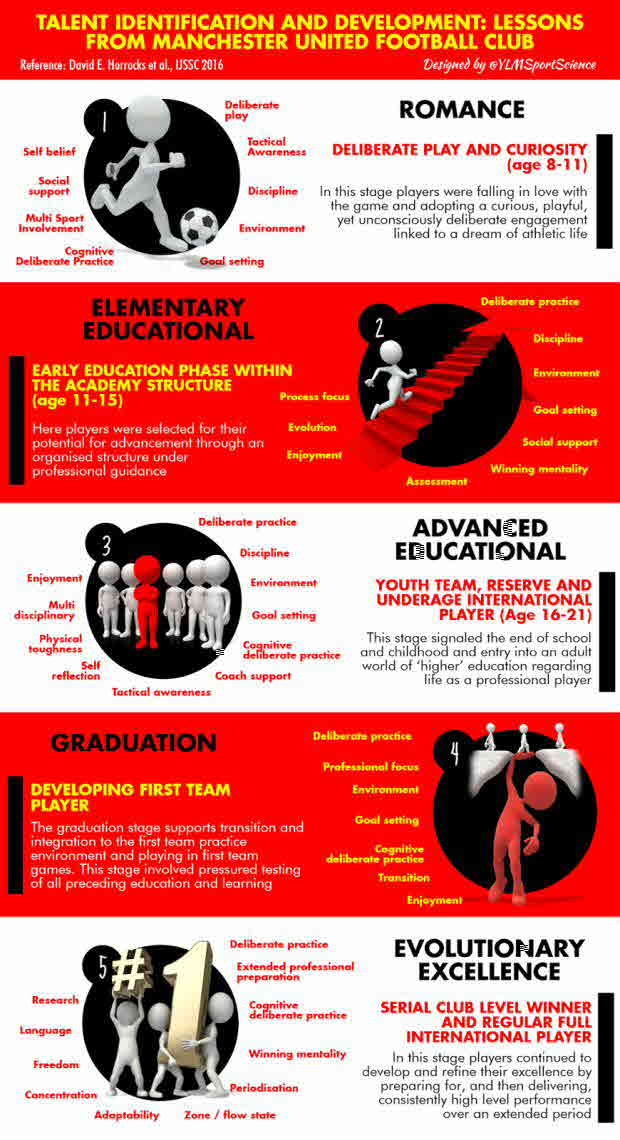
© Copyright 2016 YLMSportScience. Alle Rechte vorbehalten.
Talent development in sport is well represented in scientific literature. Yet, the drive to protect `trade secrets` often means that access to these high performing groups is rare, especially as these high-level performances are being delivered. This leaves the details of high-end working practices absent from current academic commentary. As a result, clubs interested in developing excellent practice are left to build on personal initiative and insight and/or custom-and-practice, which is unlikely to yield successful outcomes. To address this shortfall, the current study reports on prolonged engagement with a single high performing club, considering how their practice corresponds with existing sport talent development models. The article ends by proposing an evidence-based, football-specific model for talent development, maintained high-level performance and serial winning. This model emphasises four dominant features: culture, behavioural characteristics, practice engagement and the managing and guiding of performance `potential`. The study provides insights into the visceral reality of daily experiences across the life course of professional soccer, while advancing the evidence-base for understanding how Manchester United achieved their serial success. ABSTRACT FROM AUTHOR
siehe auch: https://ylmsportscience.files.wordpress.com/2016/01/84f1c-youth2bman2bu.png
© Copyright 2016 International Journal of Sports Science & Coaching. SAGE Publications. Veröffentlicht von SAGE Publications. Alle Rechte vorbehalten.
| Schlagworte: | |
|---|---|
| Notationen: | Trainingswissenschaft Spielsportarten Nachwuchssport |
| Veröffentlicht in: | International Journal of Sports Science & Coaching |
| Sprache: | Englisch |
| Veröffentlicht: |
SAGE Publications
2016
|
| Online-Zugang: | http://doi.org/10.1177/1747954116655053 |
| Jahrgang: | 11 |
| Heft: | 4 |
| Seiten: | 467-477 |
| Dokumentenarten: | Artikel |
| Level: | hoch |