

Intensified training supersedes the impact of heat and/or altitude for increasing performance in elite rugby union players
(Intensives Training übertrifft die Auswirkungen von Hitze und/oder Höhenlage zur Leistungssteigerung bei Elite-Rugby-Union-Spielern)
© Copyright 2021 YLMSportScience. Alle Rechte vorbehalten.
Purpose:
To investigate whether including heat and altitude exposures during an elite team-sport training camp induces similar or greater performance benefits.
Methods:
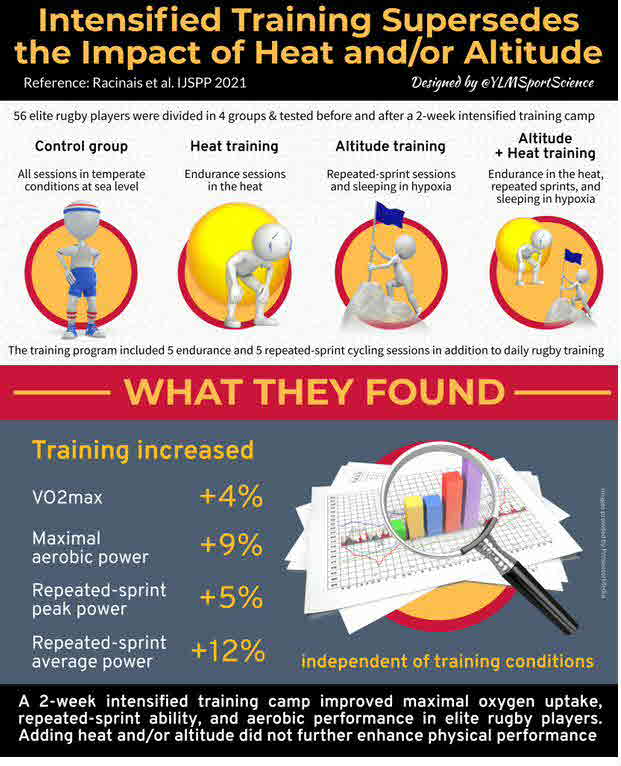
The study assessed 56 elite male rugby players for maximal oxygen uptake, repeated-sprint cycling, and Yo-Yo intermittent recovery level 2 (Yo-Yo) before and after a 2-week training camp, which included 5 endurance and 5 repeated-sprint cycling sessions in addition to daily rugby training. Players were separated into 4 groups: (1) control (all sessions in temperate conditions at sea level), (2) heat training (endurance sessions in the heat), (3) altitude (repeated-sprint sessions and sleeping in hypoxia), and (4) combined heat and altitude (endurance in the heat, repeated sprints, and sleeping in hypoxia).
Results:
Training increased maximal oxygen uptake (4% [10%], P = .017), maximal aerobic power (9% [8%], P < .001), and repeated-sprint peak (5% [10%], P = .004) and average power (12% [14%], P < .001) independent of training conditions. Yo-Yo distance increased (16% [17%], P < .001) but not in the altitude group (P = .562). Training in heat lowered core temperature and increased sweat rate during a heat-response test (P < .05).
Conclusion:
A 2-week intensified training camp improved maximal oxygen uptake, repeated-sprint ability, and aerobic performance in elite rugby players. Adding heat and/or altitude did not further enhance physical performance, and altitude appears to have been detrimental to improving Yo-Yo.
© Copyright 2021 International Journal of Sports Physiology and Performance. Alle Rechte vorbehalten.
| Schlagworte: | |
|---|---|
| Notationen: | Biowissenschaften und Sportmedizin Spielsportarten |
| Veröffentlicht in: | International Journal of Sports Physiology and Performance |
| Sprache: | Englisch |
| Veröffentlicht: |
2021
|
| Online-Zugang: | https://doi.org/10.1123/ijspp.2020-0630 |
| Jahrgang: | 16 |
| Heft: | 10 |
| Seiten: | 1416-1423 |
| Dokumentenarten: | Artikel |
| Level: | hoch |