

Effects of increased muscle strength and muscle mass on endurance-cycling performance
(Auswirkungen erhöhter Muskelkraft und Muskelmasse auf die Ausdauer-Radleistung)
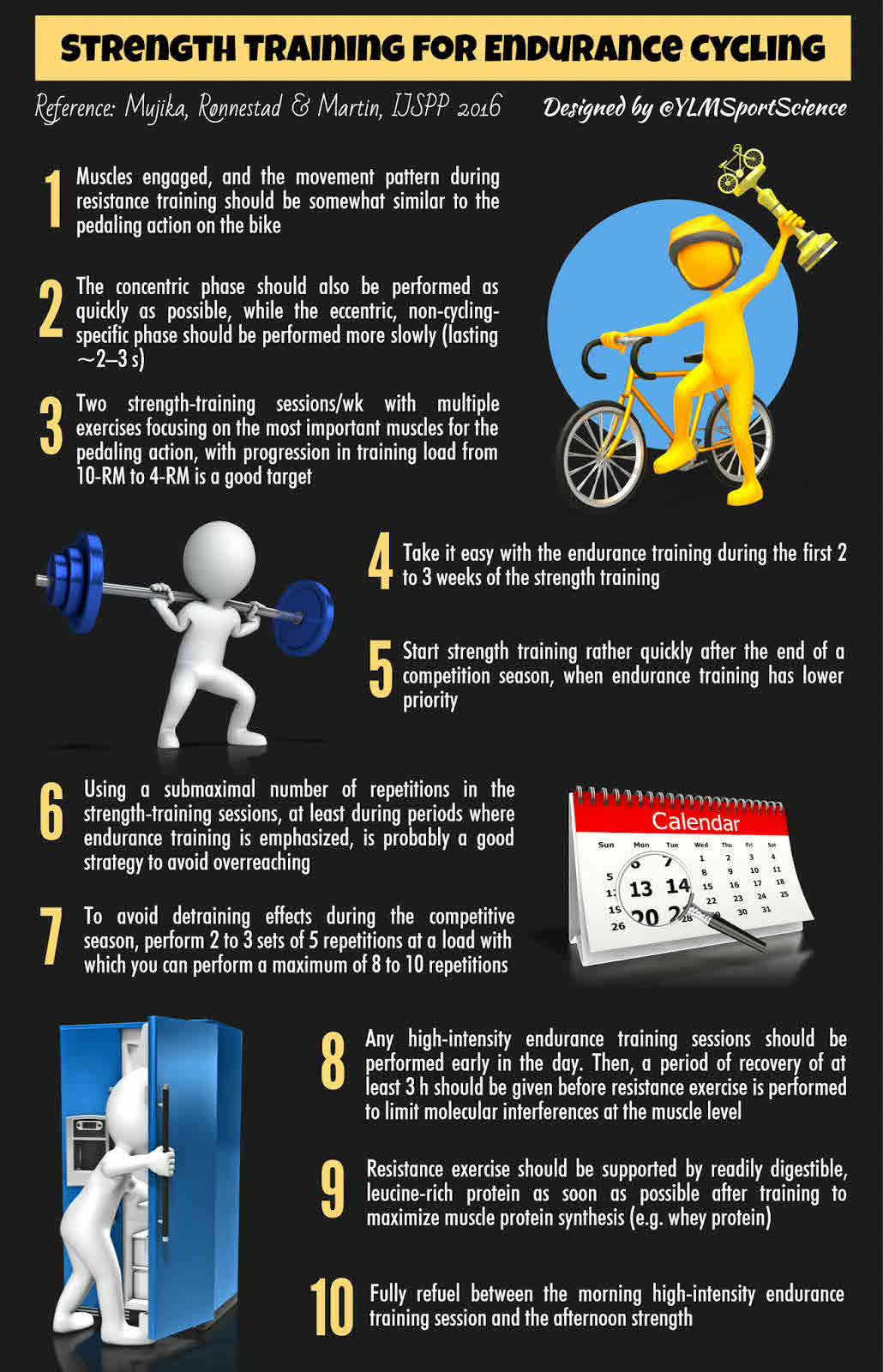
© Copyright 2016 YLMSportScience. Alle Rechte vorbehalten.
Despite early and ongoing debate among athletes, coaches, and sport scientists, it is likely that resistance training for endurance cyclists can be tolerated, promotes desired adaptations that support training, and can directly improve performance. Lower-body heavy strength training performed in addition to endurance-cycling training can improve both short- and long-term endurance performance. Strength-maintenance training is essential to retain strength gains during the competition season. Competitive female cyclists with greater lower-body lean mass (LBLM) tend to have ~4-9% higher maximum mean power per kg LBLM over 1 s to 10 min. Such relationships enable optimal body composition to be modeled. Resistance training off the bike may be particularly useful for modifying LBLM, whereas more cycling-specific training strategies like eccentric cycling and single-leg cycling with a counterweight have not been thoughtfully investigated in well-trained cyclists. Potential mechanisms for improved endurance include postponed activation of less efficient type II muscle fibers, conversion of type IIX fibers into more fatigue-resistant IIa fibers, and increased muscle mass and rate of force development.
© Copyright 2016 International Journal of Sports Physiology and Performance. Alle Rechte vorbehalten.
| Schlagworte: | |
|---|---|
| Notationen: | Biowissenschaften und Sportmedizin Ausdauersportarten |
| Tagging: | Muskelmasse fettfreie Körpermasse |
| Veröffentlicht in: | International Journal of Sports Physiology and Performance |
| Sprache: | Englisch |
| Veröffentlicht: |
2016
|
| Online-Zugang: | http://doi.org/10.1123/ijspp.2015-0405 |
| Jahrgang: | 11 |
| Heft: | 3 |
| Seiten: | 283-289 |
| Dokumentenarten: | Artikel |
| Level: | hoch |