

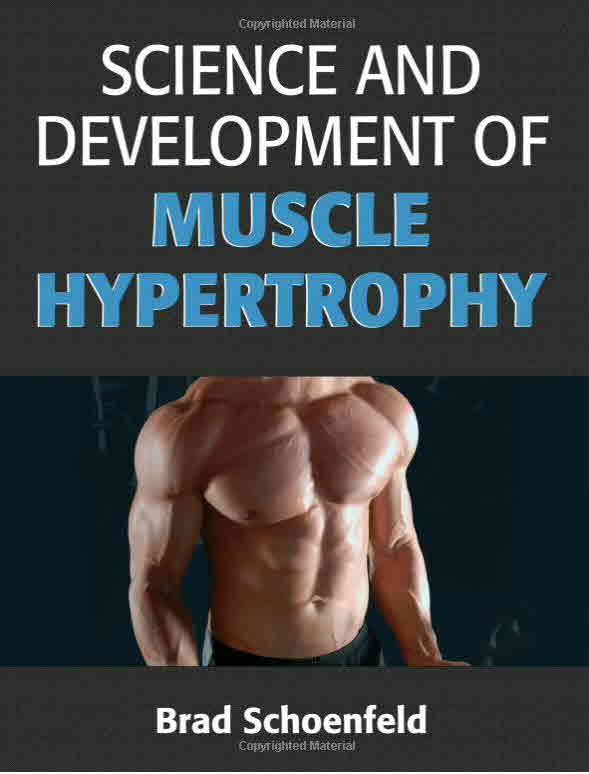
Science and development of muscle hypertrophy
(Wissenschaft und Entwicklung von Muskelhypertrophie)
Chapter 1 covers hypertrophy-related responses and adaptations to exercise stress. It provides an overview of the structure and function of the neuro-muscular system and the responses and adaptations of the neuromuscular, endocrine, paracrine, and autocrine systems. About the role of fiber types in muscle growth; the ways hypertrophy manifests; and how intrinsic and extrinsic factors drive the accretion of muscle proteins.
Chapter 2 delves into the mechanisms responsible for exercise-induced hyper-trophy. Understanding the processes involved in building muscle is essential to developing strategies for maximizing growth. About how the mechanical forces are converted into chemical signals to mediate muscle protein accretion, how the exercise-induced accumulation of metabolites stimulates the hypertrophic response, and how structural perturbations in muscle affect tissue remodeling.
Chapter 3 details the role of resistance training variables in hypertrophy. It is generally believed that the precise manipulation of these variables holds the key to the growth response. About how volume, frequency, load, exercise selection, type of muscle action, rest interval length, repetition duration, exercise order, range of motion, and effort interact to promote muscular adaptations, and how they can be altered to maximize muscle growth.
Chapter 4 explores the impact of aerobic training in hypertrophy. This is a highly nuanced topic, and misconceptions abound. About how
aerobic intensity, duration, frequency, and mode affect the hypertrophic response both when aerobic exercise is performed in isolation and when it is combined with resistance exercise (i.e., concurrent training).
Chapter 5 looks at population-specific considerations that influence muscle building. The large differences in interindividual hypertrophic response are the result of multiple factors. About how genetics, age, sex, and training experience affect the ability to increase muscle size.
Chapter 6 provides practical information on exercise program design for maximizing hypertrophy This is where the science of training becomes an art. Explains how to synergistically vary exercise selection to bring about complete muscular development, how periodization models compare with respect to promoting hypertrophic gains, and how to implement a periodized program to sustain results.
Chapter 7 examines the role of nutrition for hypertrophy. Without question, dietary intake has a profound impact on muscle-building capacity. About the effects of energy balance and macronutrients on muscle growth, the impact of meal frequency on muscle protein synthesis, and the efficacy of nutrient timing for enhancing muscular gains.
© Copyright 2016 Veröffentlicht von Human Kinetics. Alle Rechte vorbehalten.
| Schlagworte: | |
|---|---|
| Notationen: | Trainingswissenschaft |
| Sprache: | Englisch |
| Veröffentlicht: |
Champaign
Human Kinetics
2016
|
| Seiten: | 214 |
| Dokumentenarten: | Buch |
| Level: | hoch |