

The application of blood flow restriction: Lessons from the laboratory
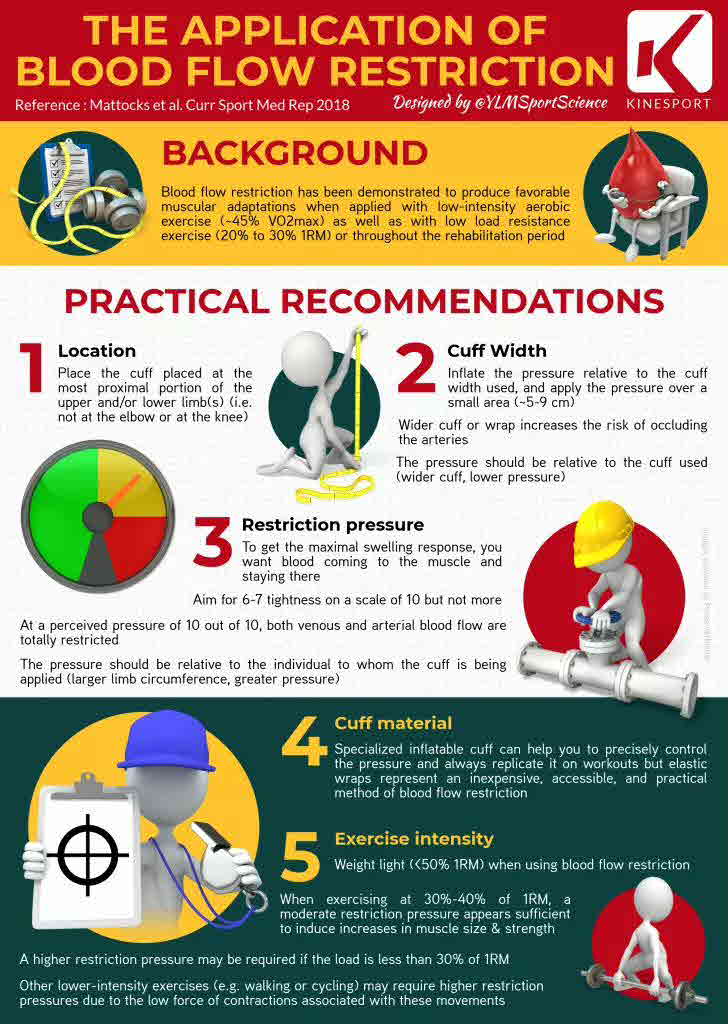
© Copyright 2018 YLMSportScience. All rights reserved.
Blood flow restriction by itself or in combination with exercise has been shown to produce beneficial adaptations to skeletal muscle. These adaptations have been observed across a range of populations, and this technique has become an attractive possibility for use in rehabilitation. Although there are concerns that applying blood flow restriction during exercise makes exercise inherently more dangerous, these concerns appear largely unfounded. Nevertheless, we have advocated that practitioners could minimize many of the risks associated with blood flow-restricted exercise by accounting for methodological factors, such as cuff width, cuff type, and the individual to which blood flow restriction is being applied. The purpose of this article is to provide an overview of these methodological factors and provide evidence-based recommendations for how to apply blood flow restriction. We also provide some discussion on how blood flow restriction may serve as an effective treatment in a clinical setting.
© Copyright 2018 Current Sports Medicine Reports. Wolters Kluwer. All rights reserved.
| Subjects: | |
|---|---|
| Notations: | biological and medical sciences |
| Tagging: | Blutfluss |
| Published in: | Current Sports Medicine Reports |
| Language: | English |
| Published: |
2018
|
| Online Access: | https://insights.ovid.com/pubmed?pmid=29629973 |
| Volume: | 17 |
| Issue: | 4 |
| Pages: | 129-134 |
| Document types: | article |
| Level: | advanced |