

Training monitoring engagement: An evidence-based approach in elite sport
© Copyright 2018 YLMSportScience. All rights reserved.
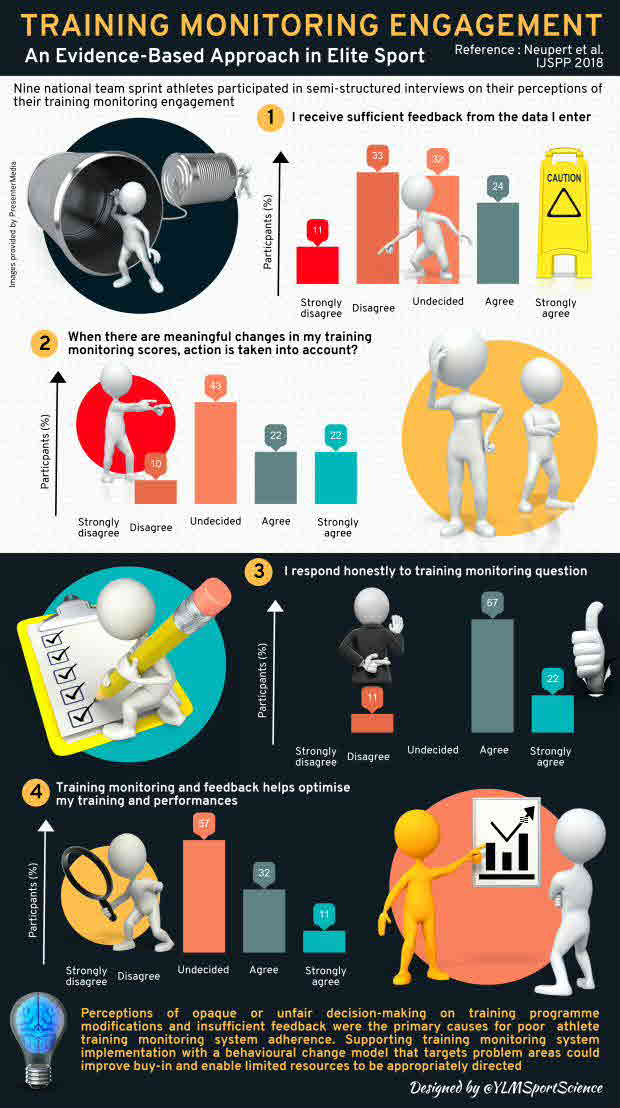
Purpose: Poor athlete buy-in and adherence to training monitoring systems (TMS) can be problematic in elite sport. This is a significant issue, as failure to record, interpret, and respond appropriately to negative changes in athlete wellbeing and training status may result in undesirable consequences, such as maladaptation and/or underperformance. This study examined the perceptions of elite athletes to their TMS, and their primary reasons for non-completion.
Methods: Nine national team sprint athletes participated in semi-structured interviews on their perceptions of their TMS. Interview data was analysed qualitatively, based on grounded theory, and TMS adherence information was collected.
Results: Thematic analysis showed that athletes reported their main reason for poor buy-in to TMS was a lack of feedback on their monitoring data from key staff. Further, training modifications made in response to meaningful changes in monitoring data were sometimes perceived to be disproportionate, resulting in dishonest reporting practices.
Conclusions: Perceptions of opaque or unfair decision-making on training programme modifications and insufficient feedback were the primary causes for poor athlete TMS adherence. Supporting TMS implementation with a behavioural change model that targets problem areas could improve buy-in and enable limited resources to be appropriately directed. Abstract from author
© Copyright 2018 International Journal of Sports Physiology and Performance. All rights reserved.
| Subjects: | |
|---|---|
| Notations: | training science |
| Published in: | International Journal of Sports Physiology and Performance |
| Language: | English |
| Published: |
2018
|
| Online Access: | https://journals.humankinetics.com/doi/10.1123/ijspp.2018-0098 |
| Volume: | 14 |
| Issue: | 1 |
| Pages: | 99-104 |
| Document types: | article |
| Level: | advanced |