

Temperate performance benefits after heat, but not combined heat and hypoxic training
© Copyright 2017 YLMSportScience. All rights reserved.
Purpose: Independent heat and hypoxic exposure can enhance temperate endurance performance in trained athletes, although their combined effects remain unknown. This study examined whether the addition of heat interval training during "live high, train low" (LHTL) hypoxic exposure would result in enhanced performance and physiological adaptations as compared with heat or temperate training.
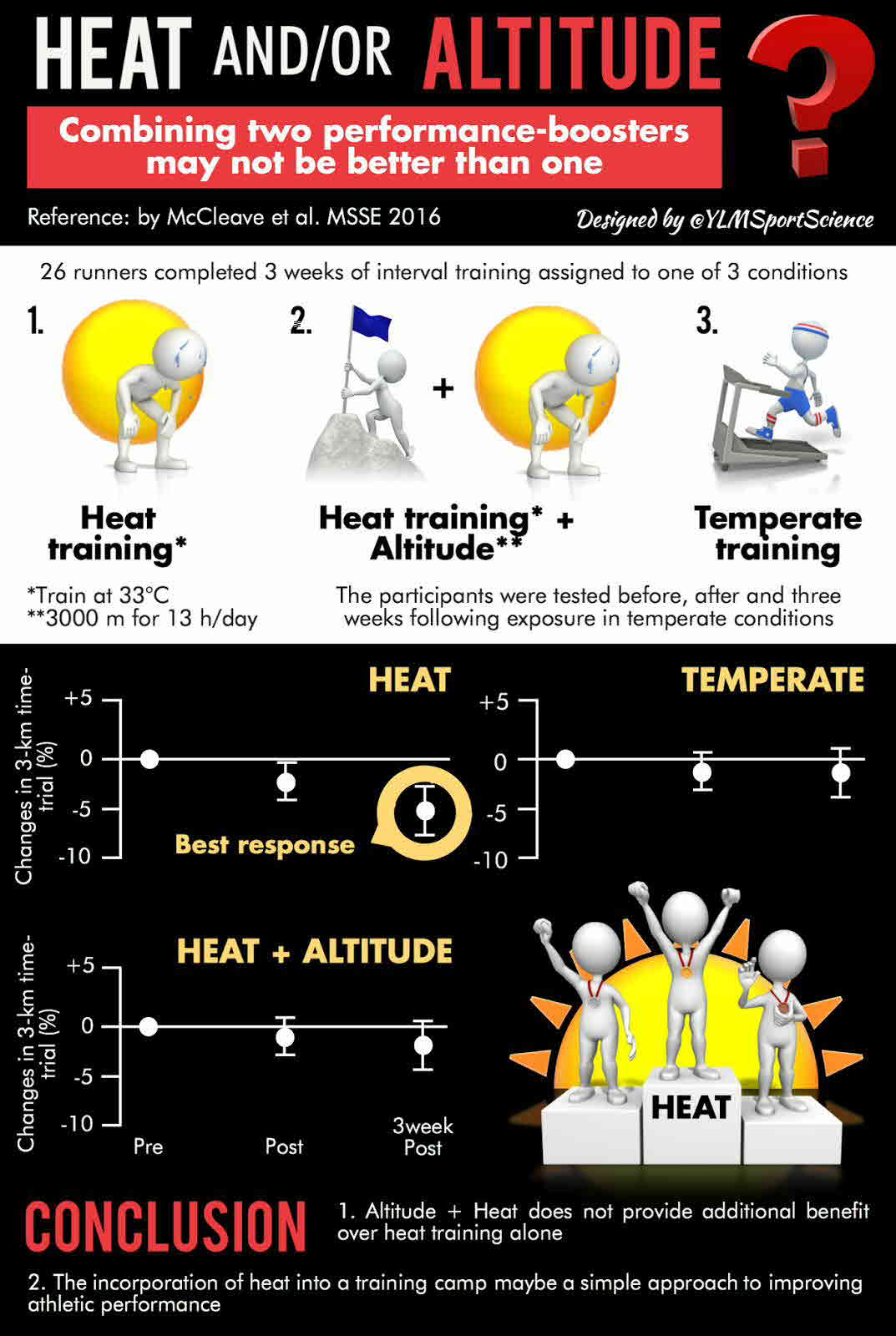
Methods: Twenty-six well-trained runners completed 3 wk of interval training assigned to one of three conditions: 1) LHTL hypoxic exposure plus heat training (H + H; 3000 m for 13 h·d-1, train at 33°C, 60% relative humidity [RH]), 2) heat training with no hypoxic exposure (HOT, live at <600 m and train at 33°C, 60% RH), or 3) temperate training with no hypoxic exposure (CONT; live at <600 m and train at 14°C, 55% RH). Performance 3-km time-trials (3-km TT), running economy, hemoglobin mass, and plasma volume were assessed using magnitude-based inferences statistical approach before (Baseline), after (Post), and 3 wk (3wkP) after exposure.
Results: Compared with Baseline, 3-km TT performance was likely increased in HOT at 3wkP (-3.3% ± 1.3%; mean ± 90% confidence interval), with no performance improvement in either H + H or CONT. Hemoglobin mass increased by 3.8% ± 1.8% at Post in H + H only. Plasma volume in HOT was possibly elevated above H + H and CONT at Post but not at 3wkP. Correlations between changes in 3-km TT performance and physiological adaptations were unclear.
Conclusion: Incorporating heat-based training into a 3-wk training block can improve temperate performance at 3 wk after exposure, with athlete psychology, physiology, and environmental dose all important considerations. Despite hematological adaptations, the addition of LHTL to heat interval training has no greater 3-km TT performance benefit than temperate training alone.
© Copyright 2017 Medicine & Science in Sports & Exercise. Lippincott Williams & Wilkins. All rights reserved.
| Subjects: | |
|---|---|
| Notations: | biological and medical sciences endurance sports |
| Published in: | Medicine & Science in Sports & Exercise |
| Language: | English |
| Published: |
2017
|
| Online Access: | http://doi.org/10.1249/MSS.0000000000001138 |
| Volume: | 49 |
| Issue: | 3 |
| Pages: | 509-517 |
| Document types: | article |
| Level: | advanced |