

Effects of tapering on neuromuscular and metabolic fitness in team sports: a systematic review and meta-analysis
© Copyright 2021 YLMSportScience. All rights reserved.
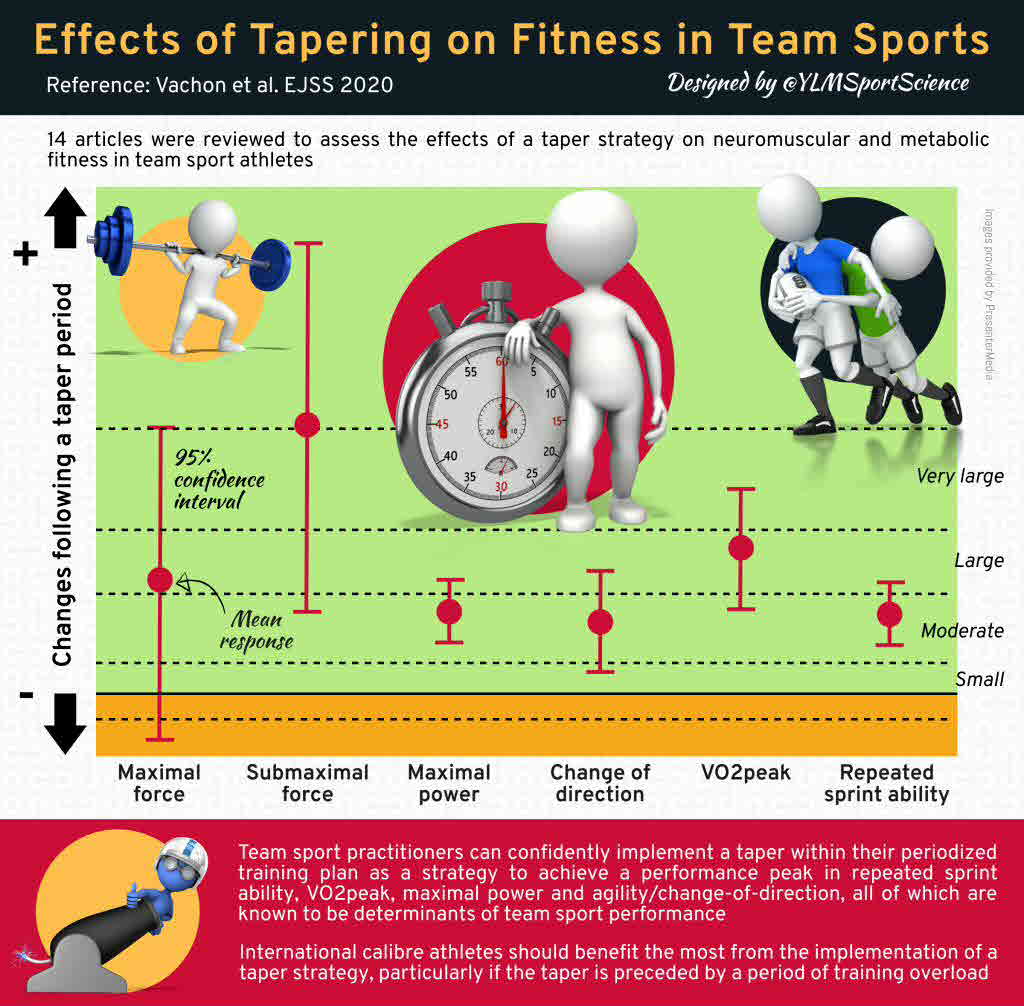
Purpose: To assess the effects of a taper strategy on neuromuscular and metabolic fitness in team sport athletes, through a systematic review and meta-analysis. Method: To be included in this meta-analysis, studies had to involve competitive team sport athletes and a tapering intervention providing details about the procedures used to decrease the training load, as well as competition or field-based criterion performance and all necessary data to calculate effect sizes. Four databases were searched according to these criteria, which led to the identification of 895 potential studies and the subsequent inclusion of 14 articles. Independent variables were training intensity, volume and frequency, as well as the pattern of taper and its duration. The dependent variable was performance obtained in various neuromuscular and metabolic tests. Results: There was limited evidence of a moderate taper-induced improvement in repeated sprint ability (Standardized Mean Difference (SMD) (95%IC;I2) = 0.41 (0.26-0.55;0%)) and moderate evidence of a moderate increase in maximal power (SMD (95%IC;I2) = 0.44 (0.32-0.56;15%)), change of direction speed (SMD (95%IC;I2) = 0.38 (0.15-0.60;28%)) and maximal oxygen uptake (SMD (95%IC;I2) = 0.76 (0.43-1.09;37%)). Conclusion: Tapering is an effective training strategy to improve maximal power, maximal oxygen uptake, repeated sprint ability and change of direction speed in team sports. However, the literature lacks studies using various tapering strategies to compare their effectiveness and make evidence-based recommendations. Future original studies should focus on this major issue.
© Copyright 2021 European Journal of Sport Science. Wiley. All rights reserved.
| Subjects: | |
|---|---|
| Notations: | sport games biological and medical sciences |
| Published in: | European Journal of Sport Science |
| Language: | English |
| Published: |
2021
|
| Online Access: | https://doi.org/10.1080/17461391.2020.1736183 |
| Volume: | 21 |
| Issue: | 3 |
| Pages: | 300-311 |
| Document types: | article |
| Level: | advanced |