

Eccentric muscle contractions: Risks and benefits
© Copyright 2019 YLMSportScience. All rights reserved.
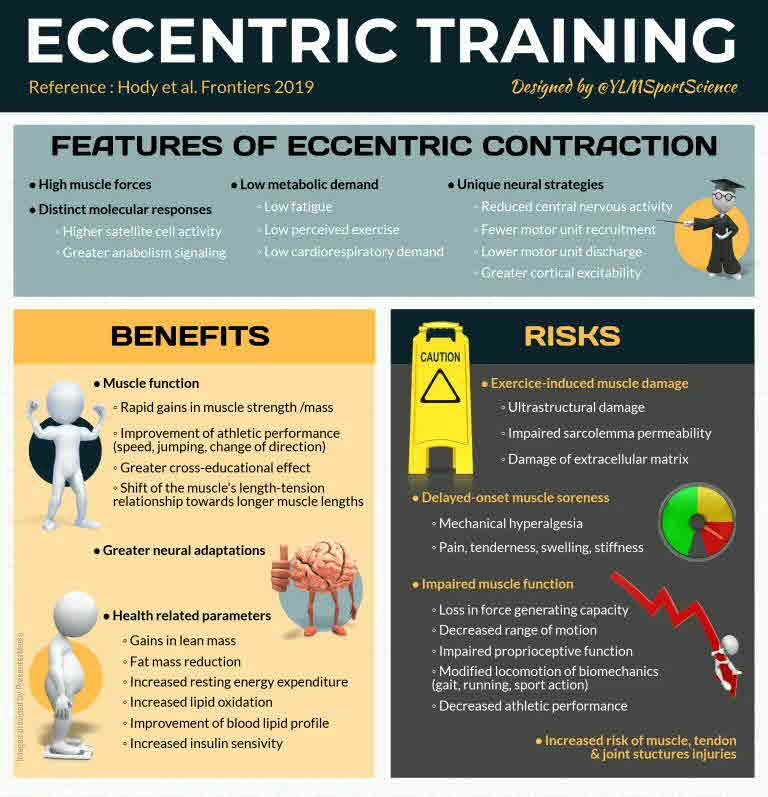
Eccentric contractions, characterized by the lengthening of the muscle-tendon complex, present several unique features compared with other types of contractions, which may lead to unique adaptations. Due to its specific physiological and mechanical properties, there is an increasing interest in employing eccentric muscle work for rehabilitation and clinical purposes. However, unaccustomed eccentric exercise is known to cause muscle damage and delayed pain, commonly defined as "Delayed-Onset Muscular Soreness" (DOMS). To date, the most useful preventive strategy to avoid these adverse effects consists of repeating sessions involving submaximal eccentric contractions whose intensity is progressively increased over the training. Despite an increased number of investigations focusing on the eccentric contraction, a significant gap still remains in our understanding of the cellular and molecular mechanisms underlying the initial damage response and subsequent adaptations to eccentric exercise. Yet, unraveling the molecular basis of exercise-related muscle damage and soreness might help uncover the mechanistic basis of pathological conditions as myalgia or neuromuscular diseases. In addition, a better insight into the mechanisms governing eccentric training adaptations should provide invaluable information for designing therapeutic interventions and identifying potential therapeutic targets.
© Copyright 2019 Frontiers in Physiology. Frontiers Media. All rights reserved.
| Subjects: | |
|---|---|
| Notations: | biological and medical sciences training science |
| Tagging: | exzentrisch |
| Published in: | Frontiers in Physiology |
| Language: | English |
| Published: |
2019
|
| Online Access: | https://www.frontiersin.org/articles/10.3389/fphys.2019.00536/full |
| Volume: | 10 |
| Pages: | 536 |
| Document types: | article |
| Level: | advanced |