

Considerations for protein intake in managing weight loss in athletes
© Copyright 2015 YLMSportScience. All rights reserved.
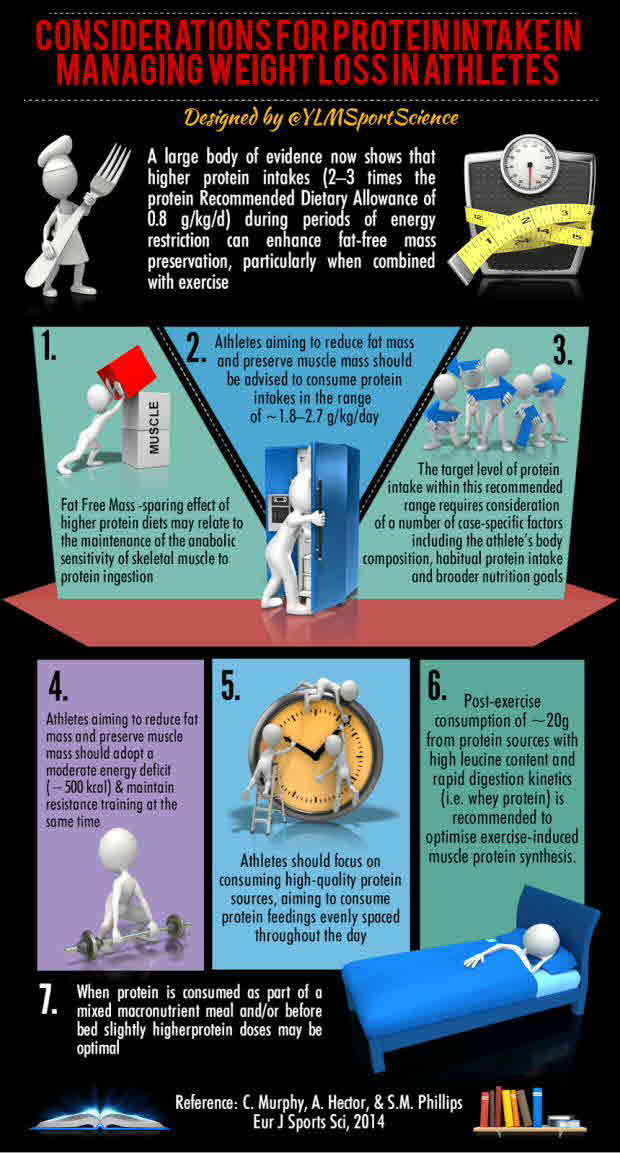
A large body of evidence now shows that higher protein intakes (2-3 times the protein Recommended Dietary Allowance (RDA) of 0.8 g/kg/d) during periods of energy restriction can enhance fat-free mass (FFM) preservation, particularly when combined with exercise. The mechanisms underpinning the FFM-sparing effect of higher protein diets remain to be fully elucidated but may relate to the maintenance of the anabolic sensitivity of skeletal muscle to protein ingestion. From a practical point of view, athletes aiming to reduce fat mass and preserve FFM should be advised to consume protein intakes in the range of ~1.8-2.7 g kg-1 d-1 (or ~2.3-3.1 g kg-1 FFM) in combination with a moderate energy deficit (-500 kcal) and the performance of some form of resistance exercise. The target level of protein intake within this recommended range requires consideration of a number of case-specific factors including the athlete's body composition, habitual protein intake and broader nutrition goals. Athletes should focus on consuming high-quality protein sources, aiming to consume protein feedings evenly spaced throughout the day. Post-exercise consumption of 0.25-0.3 g protein meal-1 from protein sources with high leucine content and rapid digestion kinetics (i.e. whey protein) is recommended to optimise exercise-induced muscle protein synthesis. When protein is consumed as part of a mixed macronutrient meal and/or before bed slightly higher protein doses may be optimal.
Volltext über: https://www.researchgate.net/publication/263862389_Considerations_for_protein_intake_in_managing_weight_loss_in_athletes
© Copyright 2015 European Journal of Sport Science. Wiley. All rights reserved.
| Subjects: | |
|---|---|
| Notations: | biological and medical sciences |
| Published in: | European Journal of Sport Science |
| Language: | English |
| Published: |
2015
|
| Online Access: | http://doi.org/10.1080/17461391.2014.936325 |
| Volume: | 15 |
| Issue: | 1 |
| Pages: | 21-28 |
| Document types: | article |
| Level: | advanced |