

Postexercise cold water immersion benefits are not greater than the placebo effect
© Copyright 2014 YLMSportScience. All rights reserved.
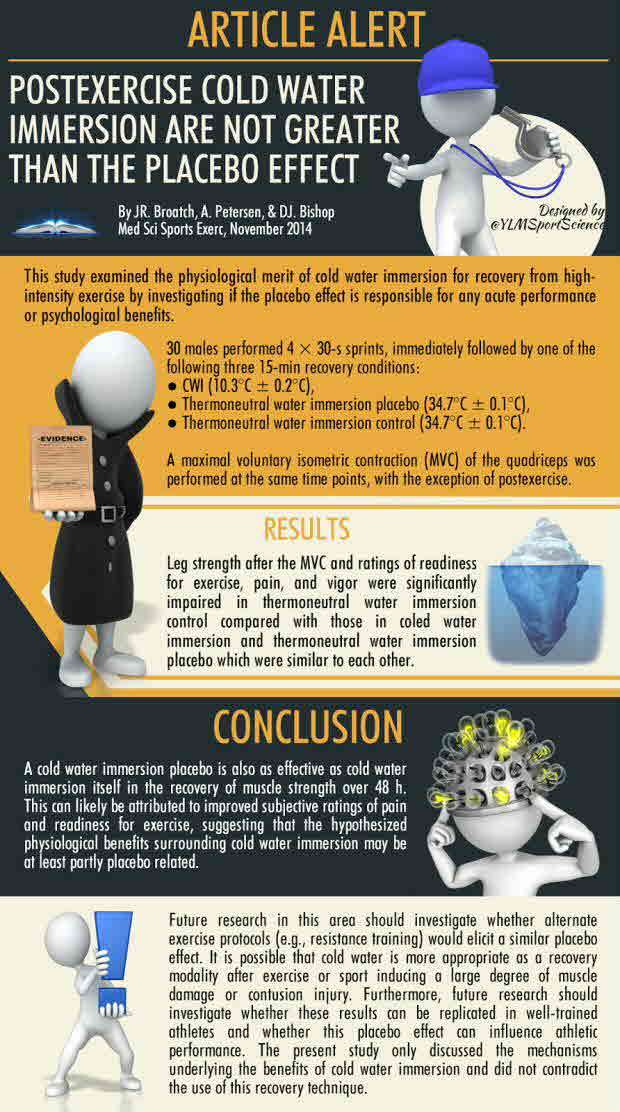
Purpose: Despite a general lack of understanding of the underlying mechanisms, cold water immersion (CWI) is widely used by athletes for recovery. This study examined the physiological merit of CWI for recovery from high-intensity exercise by investigating if the placebo effect is responsible for any acute performance or psychological benefits.
Methods: Thirty males (mean ± SD: age, 24 ± 5 yr; VO2peak, 51.1 ± 7.0 mL/kg·min) performed an acute high-intensity interval training session, comprised of 4 × 30-s sprints, immediately followed by one of the following three 15-min recovery conditions: CWI (10.3°C ± 0.2°C), thermoneutral water immersion placebo (TWP) (34.7°C ± 0.1°C), or thermoneutral water immersion control (TWI) (34.7°C ± 0.1°C). An intramuscular thermistor was inserted during exercise and recovery to record muscle temperature. Swelling (thigh girth), pain threshold/tolerance, interleukin 6 concentration, and total leukocyte, neutrophil, and lymphocyte counts were recorded at baseline, postexercise, postrecovery, and 1, 24, and 48 h postexercise. A maximal voluntary isometric contraction (MVC) of the quadriceps was performed at the same time points, with the exception of postexercise. Self-assessments of readiness for exercise, fatigue, vigor, sleepiness, pain, and belief of recovery effectiveness were also completed.
Results: Leg strength after the MVC and ratings of readiness for exercise, pain, and vigor were significantly impaired in TWI compared with those in CWI and TWP which were similar to each other.
Conclusions: A recovery placebo administered after an acute high-intensity interval training session is superior in the recovery of muscle strength over 48 h as compared with TWI and is as effective as CWI. This can be attributed to improved ratings of readiness for exercise, pain, and vigor, suggesting that the commonly hypothesized physiological benefits surrounding CWI are at least partly placebo related.
© Copyright 2014 Medicine & Science in Sports & Exercise. Lippincott Williams & Wilkins. All rights reserved.
| Subjects: | |
|---|---|
| Notations: | biological and medical sciences |
| Tagging: | Kälteapplikation Kryotherapie Kühlung |
| Published in: | Medicine & Science in Sports & Exercise |
| Language: | English |
| Published: |
2014
|
| Online Access: | http://journals.lww.com/acsm-msse/Abstract/2014/11000/Postexercise_Cold_Water_Immersion_Benefits_Are_Not.14.aspx |
| Volume: | 46 |
| Issue: | 11 |
| Pages: | 2139-2147 |
| Document types: | article |
| Level: | advanced |