

Effects of strength training on postpubertal adolescent distance runners
© Copyright 2018 YLMSportScience. All rights reserved.
PURPOSE:
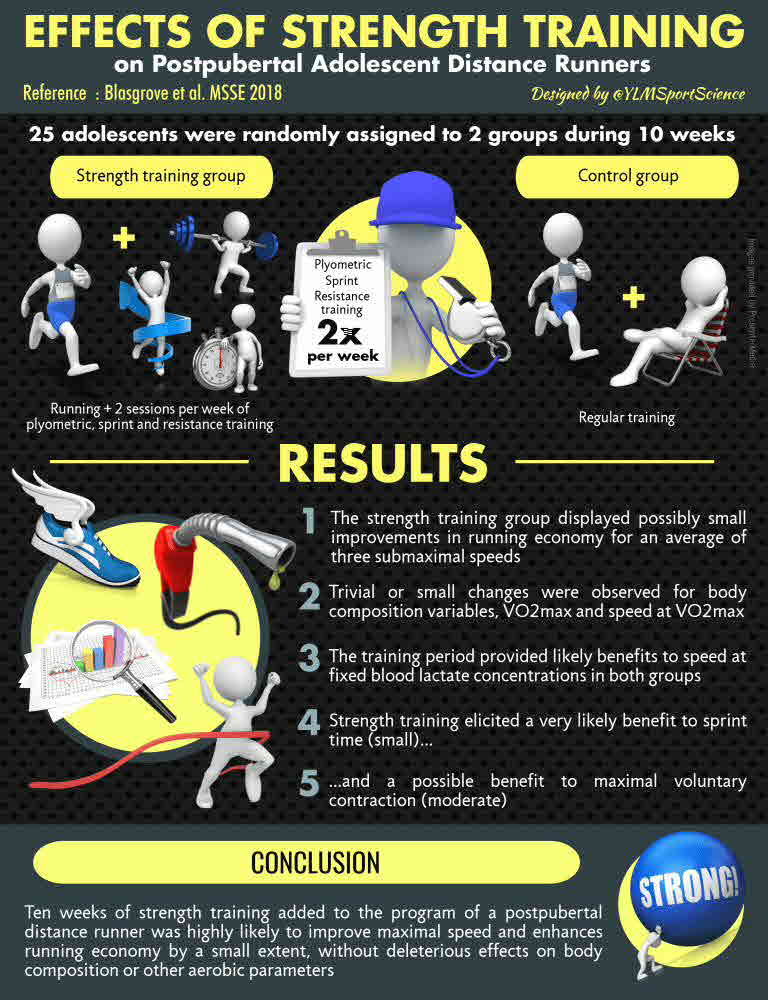
Strength training activities have consistently been shown to improve running economy (RE) and neuromuscular characteristics, such as force-producing ability and maximal speed, in adult distance runners. However, the effects on adolescent (<18 yr) runners remains elusive. This randomized control trial aimed to examine the effect of strength training on several important physiological and neuromuscular qualities associated with distance running performance.
METHODS:
Participants (n = 25, 13 female, 17.2 ± 1.2 yr) were paired according to their sex and RE and randomly assigned to a 10-wk strength training group (STG) or a control group who continued their regular training. The STG performed twice weekly sessions of plyometric, sprint, and resistance training in addition to their normal running. Outcome measures included body mass, maximal oxygen uptake (V.O2max), speed at V.O2max, RE (quantified as energy cost), speed at fixed blood lactate concentrations, 20-m sprint, and maximal voluntary contraction during an isometric quarter-squat.
RESULTS:
Eighteen participants (STG: n = 9, 16.1 ± 1.1 yr; control group: n = 9, 17.6 ± 1.2 yr) completed the study. The STG displayed small improvements (3.2%-3.7%; effect size (ES), 0.31-0.51) in RE that were inferred as "possibly beneficial" for an average of three submaximal speeds. Trivial or small changes were observed for body composition variables, V.O2max and speed at V.O2max; however, the training period provided likely benefits to speed at fixed blood lactate concentrations in both groups. Strength training elicited a very likely benefit and a possible benefit to sprint time (ES, 0.32) and maximal voluntary contraction (ES, 0.86), respectively.
CONCLUSIONS:
Ten weeks of strength training added to the program of a postpubertal distance runner was highly likely to improve maximal speed and enhances RE by a small extent, without deleterious effects on body composition or other aerobic parameters.
Corrigendum
Medicine & Science in Sports & Exercise 50 (2018) 10, p. 218
© Copyright 2018 Medicine & Science in Sports & Exercise. Lippincott Williams & Wilkins. All rights reserved.
| Subjects: | |
|---|---|
| Notations: | junior sports |
| Published in: | Medicine & Science in Sports & Exercise |
| Language: | English |
| Published: |
2018
|
| Online Access: | http://doi.org/10.1249/MSS.0000000000001543 |
| Volume: | 50 |
| Issue: | 6 |
| Pages: | 1224-1232 |
| Document types: | article |
| Level: | advanced |