

Determinant factors of repeat sprint sequences in young soccer players
© Copyright 2015 YLMSportScience. All rights reserved.
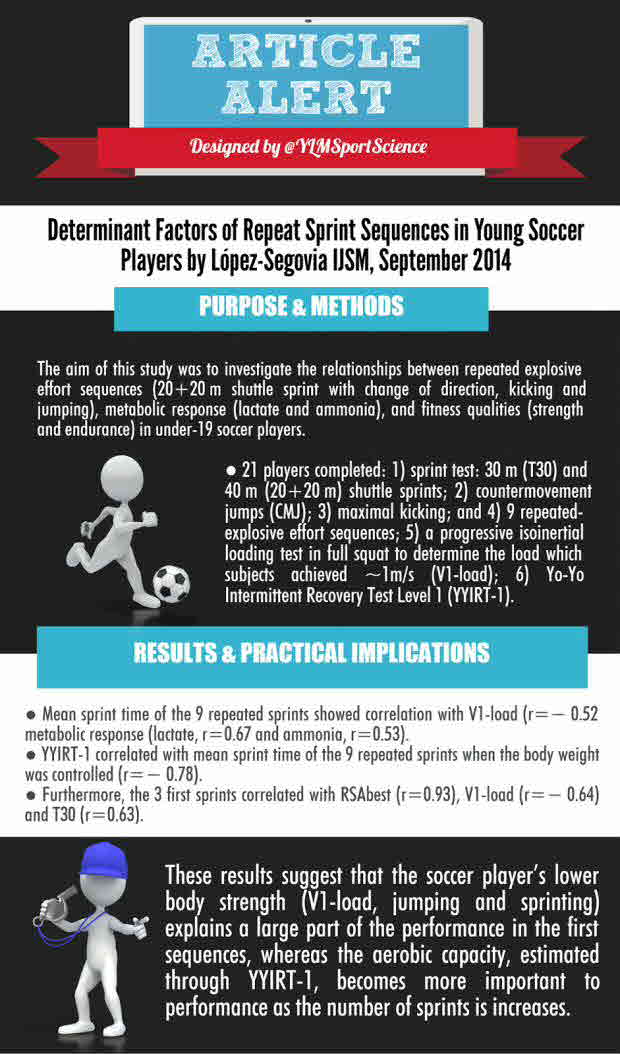
The aim of this study was to investigate the relationships between repeated explosive effort sequences (20+20 m shuttle sprint with change of direction, kicking and jumping), metabolic response (lactate and ammonia), and fitness qualities (strength and endurance) in under-19 soccer players. 21 players completed: 1) sprint test: 30 m (T30) and 40 m (20+20 m) shuttle sprints; 2) countermovement jumps (CMJ); 3) maximal kicking; and 4) 9 repeated-explosive effort sequences (RES); 4) a progressive isoinertial loading test in full squat to determine the load which subjects achieved ~1 m · s-1 (V1-load); 6) Yo-Yo Intermittent Recovery Test Level 1 (YYIRT-1). Mean sprint time of the 9 repeated sprints (RSAmean1-9) showed correlation with V1-load (r=- 0.52 [- 0.79, - 0.25]) metabolic response (lactate, r=0.67 [0.47, 0.87] and ammonia, r=0.53 [0.27, 0.79]). YYIRT-1 correlated with RSAmean1-9 (rw=- 0.78 [- 0.92, - 0.64]) when the body weight was controlled. Furthermore, the 3 first sprints (RSAmean1-3) correlated with RSAbest (r=0.93 [0.88, 0.98]), V1-load (r=- 0.64 [-0.86, - 0.42]), and T30 (r=0.63 [0.41, 0.85]). These results suggest that the soccer player`s lower body strength (V1-load, jumping and sprinting) explains a large part of the performance in the first sequences, whereas the aerobic capacity, estimated through YYIRT-1, becomes more important to performance as the number of sprints is increases.
© Copyright 2015 International Journal of Sports Medicine. Thieme. All rights reserved.
| Subjects: | |
|---|---|
| Notations: | sport games junior sports |
| Published in: | International Journal of Sports Medicine |
| Language: | English |
| Published: |
2015
|
| Online Access: | http://doi.org/10.1055/s-0034-1385880 |
| Volume: | 36 |
| Issue: | 2 |
| Pages: | 130-136 |
| Document types: | article |
| Level: | advanced |