

The road to gold: Training and peaking characteristics in the year prior to a gold medal endurance performance
© Copyright 2014 YLMSportScience. Все права защищены.
Purpose: To describe training variations across the annual cycle in Olympic and World Champion endurance athletes, and determine whether these athletes used tapering strategies in line with recommendations in the literature.
Methods: Eleven elite XC skiers and biathletes (4 male; 2861 yr, 8565 mL. min21. kg21 _VVO2max, 7 female, 2564 yr, 7363 mL. min21. kg21 _VVO2max) reported one year of day-to-day training leading up to the most successful competition of their career. Training data were divided into periodization and peaking phases and distributed into training forms, intensity zones and endurance activity forms.
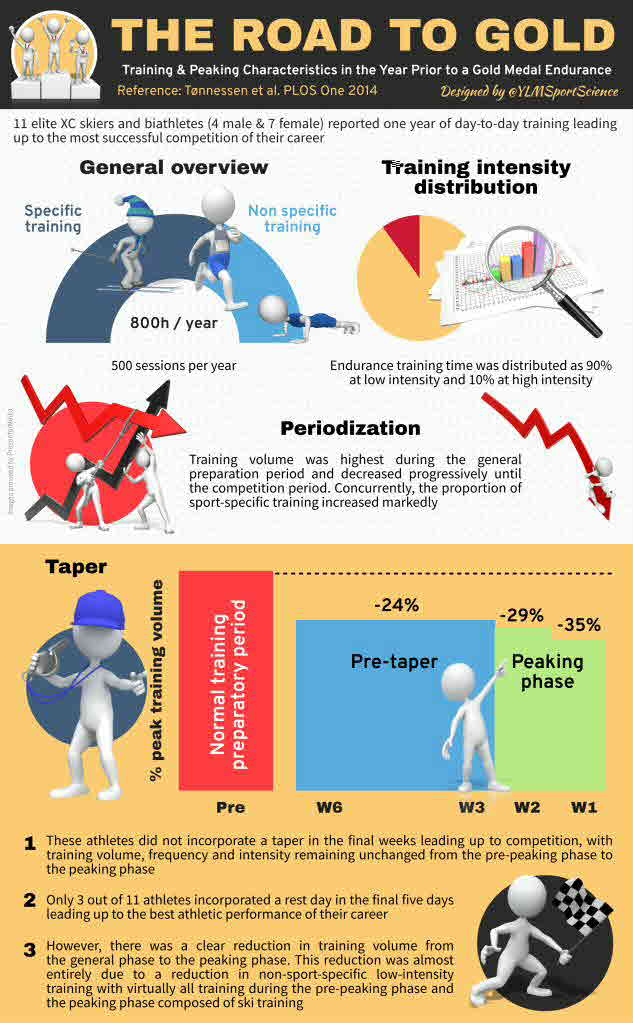
Results: Athletes trained ,800 h/500 sessions.year21, including ,500 h. year21 of sport-specific training. Ninety-four percent of all training was executed as aerobic endurance training. Of this, ,90% was low intensity training (LIT, below the first lactate threshold) and 10% high intensity training (HIT, above the first lactate threshold) by time. Categorically, 23% of training sessions were characterized as HIT with primary portions executed at or above the first lactate turn point. Training volume and specificity distribution conformed to a traditional periodization model, but absolute volume of HIT remained stable across phases. However, HIT training patterns tended to become more polarized in the competition phase. Training volume, frequency and intensity remained unchanged from pre-peaking to peaking period, but there was a 32615% (P, .01) volume reduction from the preparation period to peaking phase.
Conclusions: The annual training data for these Olympic and World champion XC skiers and biathletes conforms to previously reported training patterns of elite endurance athletes. During the competition phase, training became more sport-specific, with 92% performed as XC skiing. However, they did not follow suggested tapering practice derived from short-term experimental studies. Only three out of 11 athletes took a rest day during the final 5 days prior to their most
successful competition.
© Copyright 2014 PLOS ONE. Public Library of Science. Все права защищены.
| Предметы: |
вид спорта на выносливость
спорт высших достижений
спорт высших достижений
биатлон
лыжные гонки
планирование тренировки
распределение нагрузок
интенсивность нагрузок
объем нагрузок
Норвегия
подготовительный период
период соревнований
периодизация тренировки
спортивная физиология
потребление О2
максимальный
непосредственная подготовка к соревнованиям
США
виды спорта на выносливость
наука о тренировке
биологические и медицинские науки
|
|---|---|
| нотация: | виды спорта на выносливость наука о тренировке биологические и медицинские науки |
| Опубликовано в:: | PLOS ONE |
| Язык: | английский |
| Опубликовано: |
2014
|
| Online-ссылка: | http://www.plosone.org/article/info%3Adoi%2F10.1371%2Fjournal.pone.0101796 |
| Том: | 9 |
| Выпуск: | 7 |
| Страницы: | 1-13 |
| Document types: | статья |
| Уровень: | продвинутый |