

The training and development of elite sprint performance: an integration of scientific and best practice literature
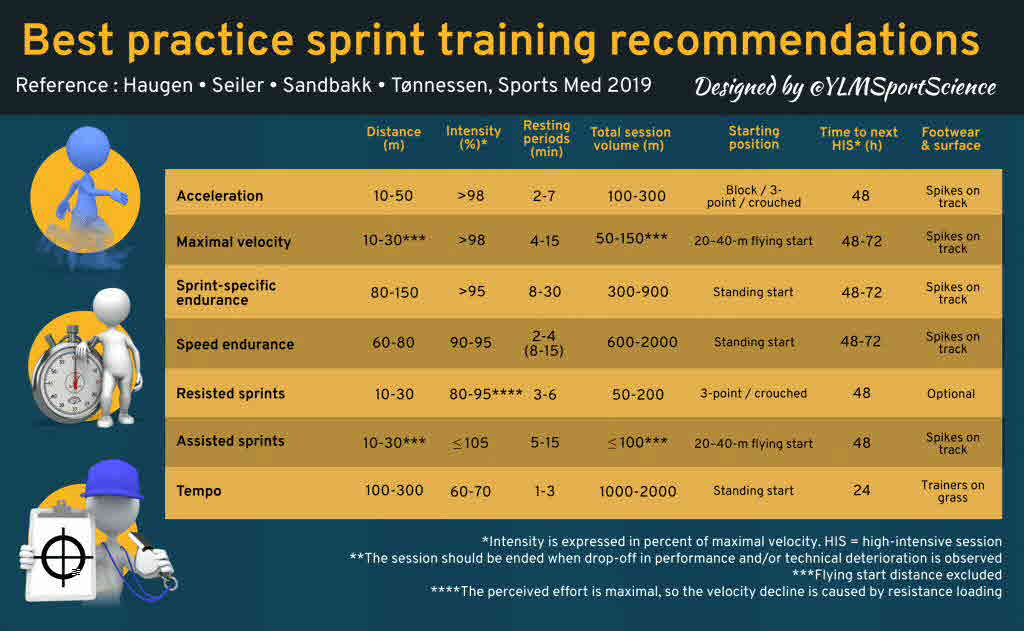
© Copyright 2019 YLMSportScience. All rights reserved.
Despite a voluminous body of research devoted to sprint training, our understanding of the training process leading to a world-class sprint performance is limited. The objective of this review is to integrate scientific and best practice literature regarding the training and development of elite sprint performance. Sprint performance is heavily dependent upon genetic traits, and the annual within-athlete performance differences are lower than the typical variation, the smallest worthwhile change, and the influence of external conditions such as wind, monitoring methodologies, etc. Still, key underlying determinants (e.g., power, technique, and sprint-specific endurance) are trainable. In this review, we describe how well-known training principles (progression, specificity, variation/periodization, and individualization) and varying training methods (e.g., sprinting/running, technical training, strength/power, plyometric training) are used in a sprint training context. Indeed, there is a considerable gap between science and best practice in how training principles and methods are applied. While the vast majority of sprint-related studies are performed on young team sport athletes and focus on brief sprints with maximal intensity and short recoveries, elite sprinters perform sprinting/running over a broad range of distances and with varying intensity and recovery periods. Within best practice, there is a stronger link between choice of training component (i.e., modality, duration, intensity, recovery, session rate) and the intended purpose of the training session compared with the "one-size-fits-all" approach in scientific literature. This review provides a point of departure for scientists and practitioners regarding the training and development of elite sprint performance and can serve as a position statement for outlining state-of-the-art sprint training recommendations and for generation of new hypotheses to be tested in future research.
Key Points:
There are considerable gaps between science and best practice in how training principles and training methods should be applied for elite sprint performance.
This review serves as a position statement for outlining state-of-the-art sprint training recommendations.
We provide a point of departure for discussion between scientists and practitioners regarding the training and development of sprint performance.
© Copyright 2019 Sports Medicine. Springer. All rights reserved.
| Subjects: |
performance
sprint
short-distance running
track and field
high performance sport
elite sport
training
development
performance development
science
training science
performance factor
physical conditioning ability
training method
training means
load
load organization
load volume
fatigue
recovery
Switzerland
strength and speed sports
|
|---|---|
| Notations: | training science strength and speed sports |
| Published in: | Sports Medicine |
| Language: | English |
| Published: |
2019
|
| Online Access: | https://doi.org/10.1186/s40798-019-0221-0 |
| Volume: | 5 |
| Issue: | 44 |
| Pages: | 1-16 |
| Document types: | article |
| Level: | advanced |