

The effect of dietary protein on protein metabolism and performance in endurance-trained males
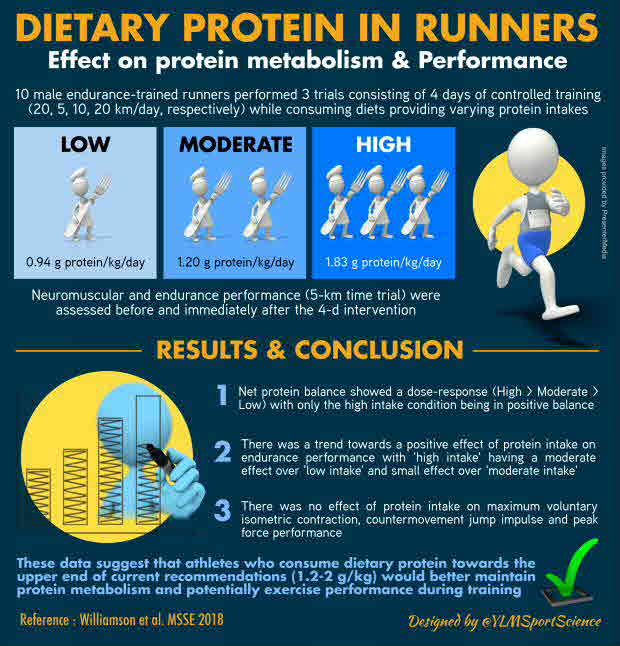
© Copyright 2019 YLMSportScience. All rights reserved.
Recommendations for dietary protein are primarily based on intakes that maintain nitrogen (i.e., protein) balance rather than optimize metabolism and/or performance.
Purpose This study aimed to determine how varying protein intakes, including a new tracer-derived safe intake, alter whole body protein metabolism and exercise performance during training.
Methods Using a double-blind randomized crossover design, 10 male endurance-trained runners (age, 32 ± 8 yr; V.O2peak, 65.9 ± 7.9 mL O2/kg·min) performed three trials consisting of 4 d of controlled training (20, 5, 10, and 20 km/d, respectively) while consuming diets providing 0.94 (LOW), 1.20 (MOD), and 1.83 (HIGH) g protein/kg·d. Whole body protein synthesis, breakdown, and net balance were determined by oral [15N]glycine on the first and last day of the 4-d controlled training period, whereas exercise performance was determined from maximum voluntary isometric contraction, 5-km time trial, and countermovement jump impulse (IMP) and peak force before and immediately after the 4-d intervention.
Results Synthesis and breakdown were not affected by protein intake, whereas net balance showed a dose-response (HIGH > MOD > LOW, P < 0.05) with only HIGH being in positive balance (P < 0.05). There was a trend (P = 0.06) toward an interaction in 5-km Time Trial with HIGH having a moderate effect over LOW (effect size = 0.57) and small effect over MOD (effect size = 0.26). IMP decreased with time (P < 0.01) with no effect of protein (P = 0.56). There was no effect of protein intake (P = 0.06) on maximum voluntary isometric contraction, IMP, or peak force performance.
Conclusion Our data suggest that athletes who consume dietary protein toward the upper end of the current recommendations by the American College of Sports Medicine (1.2-2 g/kg) would better maintain protein metabolism and potentially exercise performance during training.
© Copyright 2019 Medicine & Science in Sports & Exercise. Lippincott Williams & Wilkins. All rights reserved.
| Subjects: | |
|---|---|
| Notations: | biological and medical sciences endurance sports |
| Published in: | Medicine & Science in Sports & Exercise |
| Language: | English |
| Published: |
2019
|
| Online Access: | http://doi.org/10.1249/MSS.0000000000001791 |
| Volume: | 51 |
| Issue: | 2 |
| Pages: | 352-360 |
| Document types: | article |
| Level: | advanced |